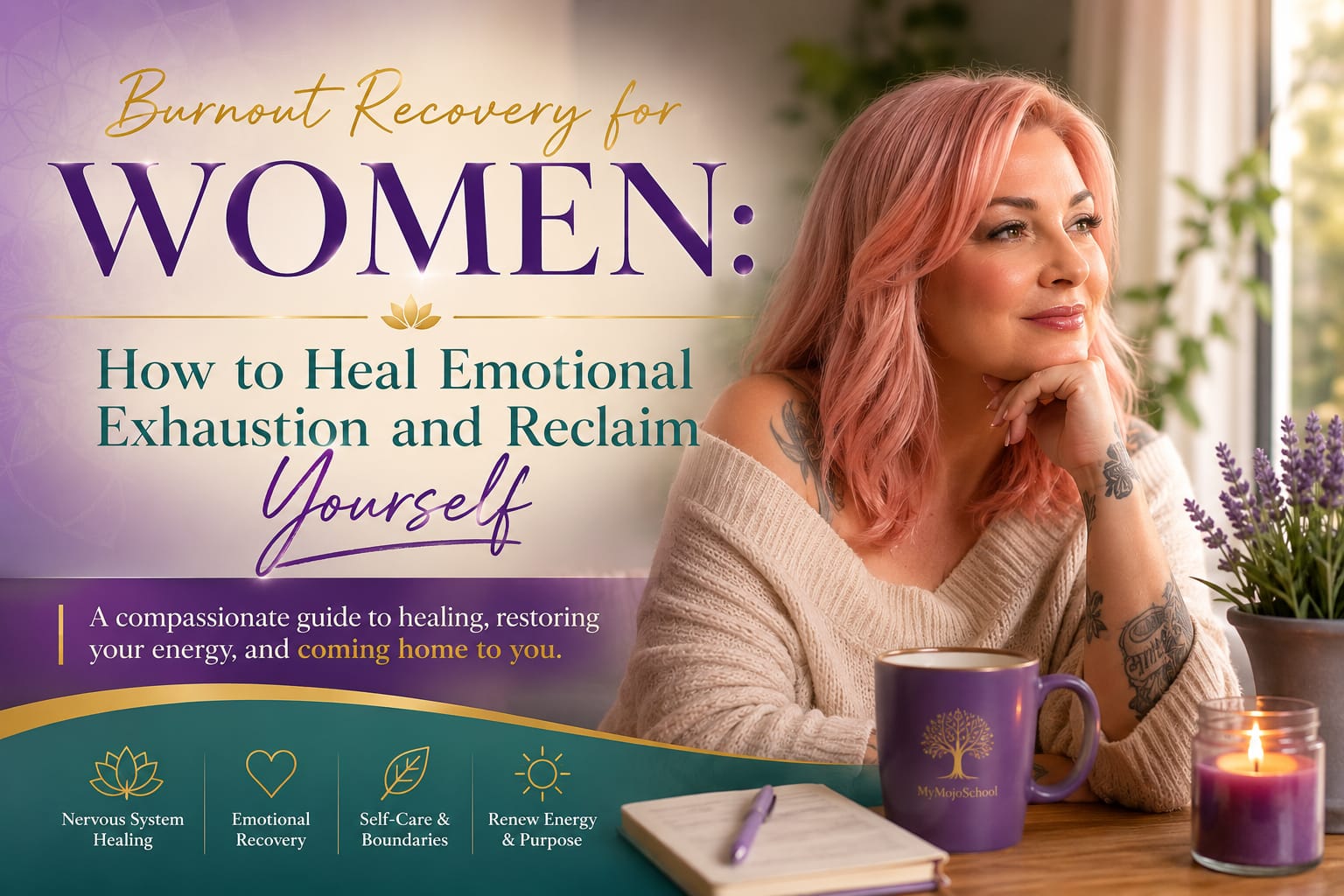
Burnout Recovery for Women: How to Heal Emotional Exhaustion and Reclaim Yourself
You didn’t just wake up one day exhausted.
It happened slowly — so slowly you almost didn’t notice. The mornings that used to feel manageable started feeling impossible. The things that once brought you joy began feeling like obligations. You started running on caffeine, willpower, and the quiet hope that if you just pushed through a little longer, you’d come out the other side.
But you haven’t. And now you’re here — emotionally spent, mentally overwhelmed, and wondering whether this is just how life feels now.
It isn’t. And what you’re experiencing has a name.
What Burnout Actually Feels Like for Women (And Why It’s Different)
Most conversations about burnout describe it as a workplace problem. And while work certainly contributes, for many women the picture is far more complex.
Women often carry a uniquely invisible load — the emotional labour of relationships, the mental load of family management, the pressure of professional performance, and the deeply conditioned belief that they should be able to handle all of it without complaint. When all of that weight finally becomes too much, burnout doesn’t just feel like tiredness. It feels like a kind of collapse — emotional, mental, physical, and sometimes spiritual.
You might recognise yourself in some of these experiences:
The Signs of Emotional Burnout Women Often Overlook
- You feel emotionally numb — not sad exactly, but flat. Like someone turned the volume down on your feelings.
- You’re exhausted no matter how much you sleep. Rest doesn’t restore you the way it used to.
- You’ve lost interest in things that used to matter to you — hobbies, friendships, even your own goals.
- You feel detached from your life, like you’re watching it from the outside.
- Everyday decisions feel overwhelming. Small things feel enormous.
- You feel a low hum of anxiety almost constantly, even when nothing specific is wrong.
- You’ve started snapping at the people you love — and then feeling crushing guilt about it.
- You can’t remember the last time you felt genuinely like yourself.
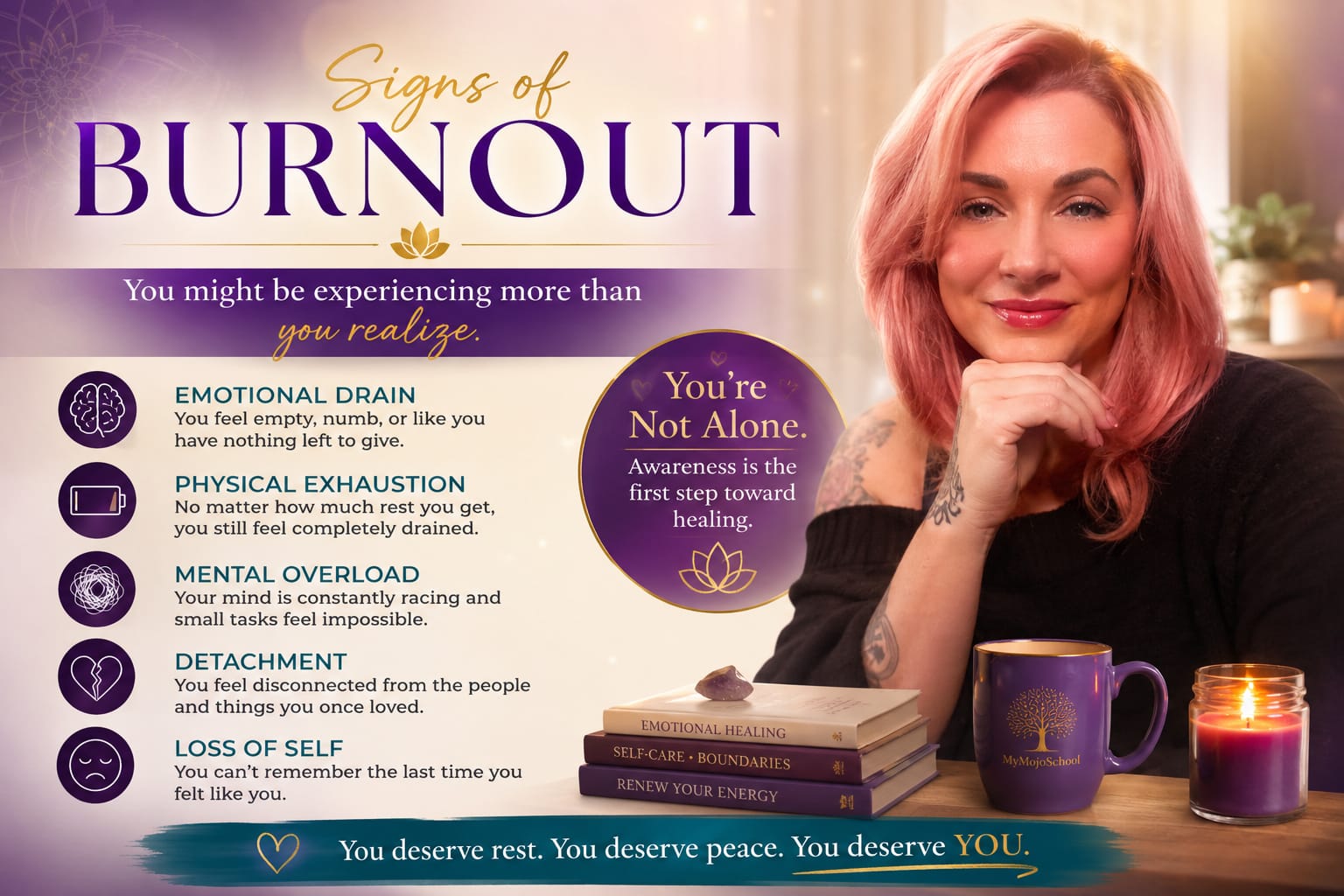
Emotional burnout often begins quietly — through exhaustion, emotional overload, and the feeling of constantly carrying too much alone.
Why Women Are Disproportionately Affected by Burnout
This isn’t about weakness. It’s about weight.
Research consistently shows that women experience burnout at higher rates than men — and the reasons go beyond workplace pressure. Women are far more likely to be primary caregivers, emotionally responsible for relationships, and conditioned to suppress their own needs in service of others. The message many women absorb from childhood is clear: be capable, be kind, be available, be everything — and do it quietly.
That conditioning doesn’t disappear in adulthood. It accumulates.
Add to that the particular pressures of midlife — shifting hormones, evolving identities, ageing parents, growing children, career demands, and relationships that also require tending — and it becomes less surprising that so many women reach a point of complete emotional depletion somewhere in their late thirties or forties.
The Hidden Burnout Women Don’t Talk About
There are forms of burnout that almost never appear in mainstream wellness conversations:
Caregiver Burnout — the emotional and physical depletion that comes from caring for children, elderly parents, or a partner with health challenges. This is one of the most severe forms of burnout and one of the least acknowledged.
Relational Burnout — the exhaustion that builds when you’ve been the emotional anchor for everyone around you for years, without anyone holding that space for you.
Identity Burnout — perhaps the most quietly devastating kind. This is when you’ve been so many things to so many people for so long that you’ve genuinely lost touch with who you are outside of your roles. You look in the mirror and don’t quite recognise the woman looking back.
Spiritual Burnout — when you’ve lost the sense of meaning, purpose, or connection that once made life feel worth showing up for. Not depression, exactly — more like a quiet hollowing out.
All of these are real. All of them deserve recovery. And all of them are addressable — with the right understanding and the right support.
Understanding What’s Happening in Your Body During Burnout
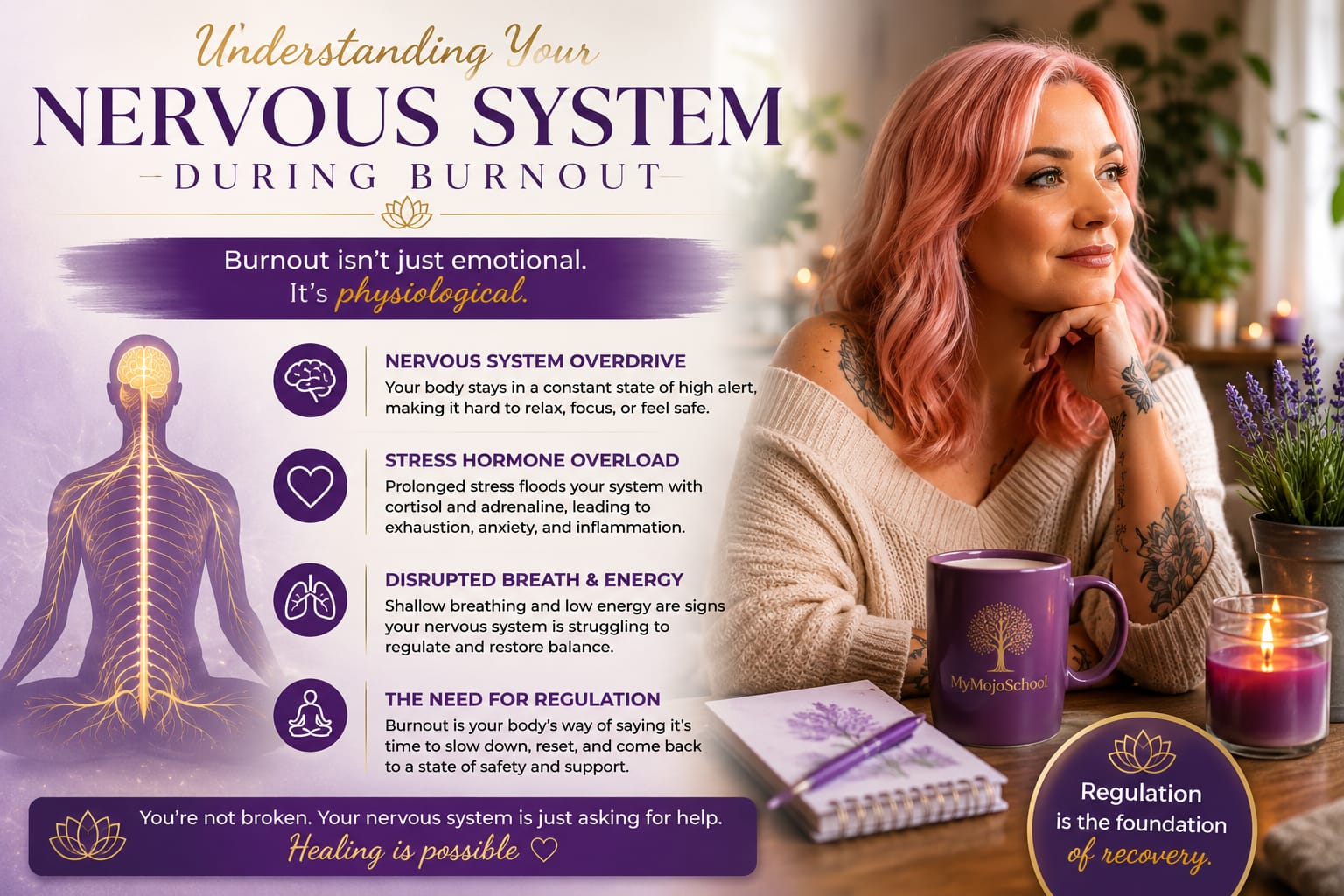
Burnout is not only emotional. It affects the nervous system, stress hormones, sleep, emotional regulation, and the body’s ability to recover.
Burnout isn’t just emotional. It’s physiological.
When you’ve been operating under chronic stress for an extended period, your nervous system — specifically the part responsible for your threat response — has been running in overdrive. Your body has been producing stress hormones like cortisol and adrenaline as if you were in a prolonged emergency. Over time, this wears down your system’s ability to regulate itself.
This is why burnout often feels different from ordinary tiredness. Ordinary tiredness is resolved by rest. Burnout is a state of nervous system dysregulation — your body’s stress-response system has become stuck in a pattern of high alert or, in later stages, complete shutdown.
This is why you might feel simultaneously exhausted and anxious. Or why you sleep for nine hours and wake up feeling worse. Or why rest doesn’t seem to touch the exhaustion. Your nervous system isn’t in a state where it can receive the benefits of rest in the usual way.
Understanding this matters — because it changes how you approach recovery.
Burnout vs. Depression: Understanding the Difference
One of the most common fears women bring to conversations about burnout is: “What if it’s actually depression?”
This is an important question and worth addressing honestly.
Burnout and depression can share symptoms — low mood, loss of motivation, difficulty finding joy, exhaustion, withdrawal. But there are meaningful differences:
- Burnout is typically tied to a specific context or set of demands. Depression tends to be more pervasive and less context-specific.
- Burnout often improves with genuine rest, recovery, and the removal or reduction of the stressor. Depression typically requires more sustained therapeutic or medical intervention.
- Burnout tends to involve emotional flatness or numbness. Depression often carries a heavier emotional weight — persistent sadness, hopelessness, or emptiness.
That said, prolonged burnout can develop into clinical depression if left unaddressed. If you’re uncertain, speaking with a mental health professional is always a wise and self-respecting choice.
The Stages of Burnout Recovery (And Why It’s Not Linear)
One of the things that makes burnout recovery genuinely hard is that it doesn’t follow a neat, predictable path. You won’t simply rest for two weeks and feel restored. Recovery unfolds in layers — and sometimes you’ll feel you’ve taken two steps forward before something pulls you back.
Understanding the stages of recovery can help you stop pathologising your own healing.
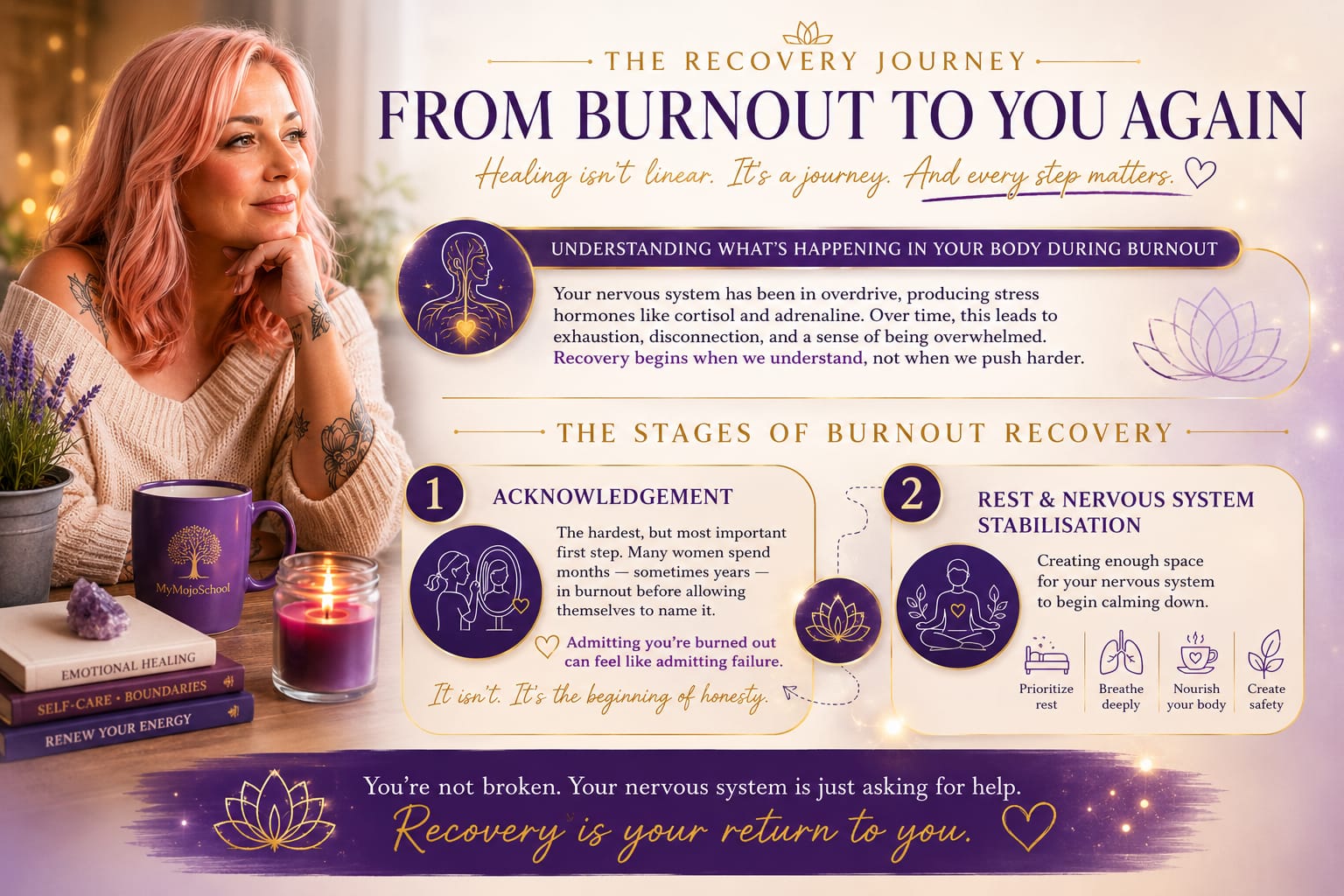
Recovery from burnout is rarely linear. Healing usually happens gradually through rest, emotional processing, nervous system stabilisation, and rebuilding self-trust.
Acknowledgement
This is often the hardest stage. Many women spend months — sometimes years — in burnout before allowing themselves to name it. Admitting you’re burned out can feel like admitting failure. It isn’t. It’s the beginning of honesty.
Rest & Nervous System Stabilisation
Creating enough space for your nervous system to begin calming down. Prioritising sleep as a non-negotiable. Removing or limiting inputs that keep the nervous system activated. Beginning to practise small moments of genuine, truly restorative stillness.
Emotional Processing
As the nervous system begins to stabilise, emotions that have been suppressed or numbed often surface. You might find yourself unexpectedly tearful, or angry, or flooded with feelings you couldn’t access before. This is not regression. This is healing.
Rebuilding Identity & Meaning
Burnout doesn’t just deplete you — it can strip away your sense of self. The work of this stage is not returning to who you were before burnout. That version of you led here. This is about discovering who you want to become instead.
Sustainable Restoration
Not the absence of stress, but genuine resilience — knowing yourself deeply, understanding your limits honestly, and having the tools to recover when life becomes demanding again. Being able to rest without guilt. Knowing what nourishes you.
A Practical Burnout Recovery Plan for Women
Knowing the stages is one thing. Having a practical framework to work within is another. Here is a realistic, emotionally intelligent approach to burnout recovery — one that acknowledges the real constraints most women are working within.
The First 30 Days: Stabilisation
The first month of burnout recovery is not about transformation. It’s about stabilisation. Your goal is simply to reduce the demand on your system and create small pockets of genuine rest.
- Audit your obligations — look honestly at what you’re doing out of genuine necessity versus habit, obligation, or fear of disappointing others.
- Protect your sleep — prioritise consistent sleep over almost everything else during this period.
- Reduce decision fatigue — simplify wherever you can: meals, scheduling, commitments.
- Choose one restorative practice — not ten, one. Something genuinely calming you can maintain.
- Tell someone — burnout thrives in silence. Tell one person you trust that you’re not okay.
Days 30–90: Emotional Recovery
- Journalling for emotional release — honest, unfiltered writing about how you actually feel. Not gratitude lists.
- Gentle movement — walking, yoga, swimming. Movement that feels nourishing rather than punishing.
- Addressing anxiety — if anxiety is running underneath your burnout, begin to work with it directly.
- Beginning therapeutic or coaching support — having a skilled, emotionally intelligent guide can accelerate recovery significantly.
Ongoing: Building a Life That Doesn’t Lead Back Here
This is the long game — and arguably the most important phase. Because burnout rarely happens to someone once. Without real structural and psychological change, the patterns that led to burnout will lead there again.
Questions worth sitting with:
- What do I believe about my own worth that made it difficult to stop?
- Whose expectations have I been living for?
- What parts of my life are genuinely mine — and what have I built for someone else’s approval?
- What does a sustainable version of my life look like?
- What do I need to say no to, in order to have the energy to say yes to what matters?

What Doesn’t Work in Burnout Recovery (And Why)
Because so much wellness advice is well-intentioned but practically useless for someone in genuine burnout, it’s worth naming some of the approaches that tend not to help:
“Just Take a Holiday”
A week in the sun can ease surface tension, but it doesn’t address the underlying nervous system dysregulation. Most women come back from holiday to exactly the same situation — and feel the relief disappear within days.
“Exercise More”
High-intensity exercise in a state of burnout can actually worsen symptoms by further taxing an already depleted stress response. Gentle, consistent movement is far more effective.
“Think Positive”
Toxic positivity is particularly harmful to burned-out women who are already suppressing honest feelings about their situation. What’s needed isn’t more positivity — it’s more honesty, more permission, and more genuine support.
“Just Push Through It”
This is perhaps the most harmful advice of all — and the one women are most often given. Pushing through chronic burnout doesn’t lead to the other side. It leads deeper in.
The Emotional Dimension Most Recovery Plans Miss
Here is something that almost no mainstream burnout content addresses: the grief of burnout.
When you burn out — truly burn out — you often lose things. You lose time. You lose a version of yourself you may have been attached to. You lose confidence in your own capacity. Some women lose relationships that couldn’t survive the process. Some lose the career they’d built their identity around. Some simply lose the feeling that life has colour.
These are real losses. And they deserve to be grieved.
If you’re carrying grief underneath your exhaustion, that’s not a sign of weakness. It’s a sign that what happened mattered. And it deserves space.
You Don’t Have to Earn Rest
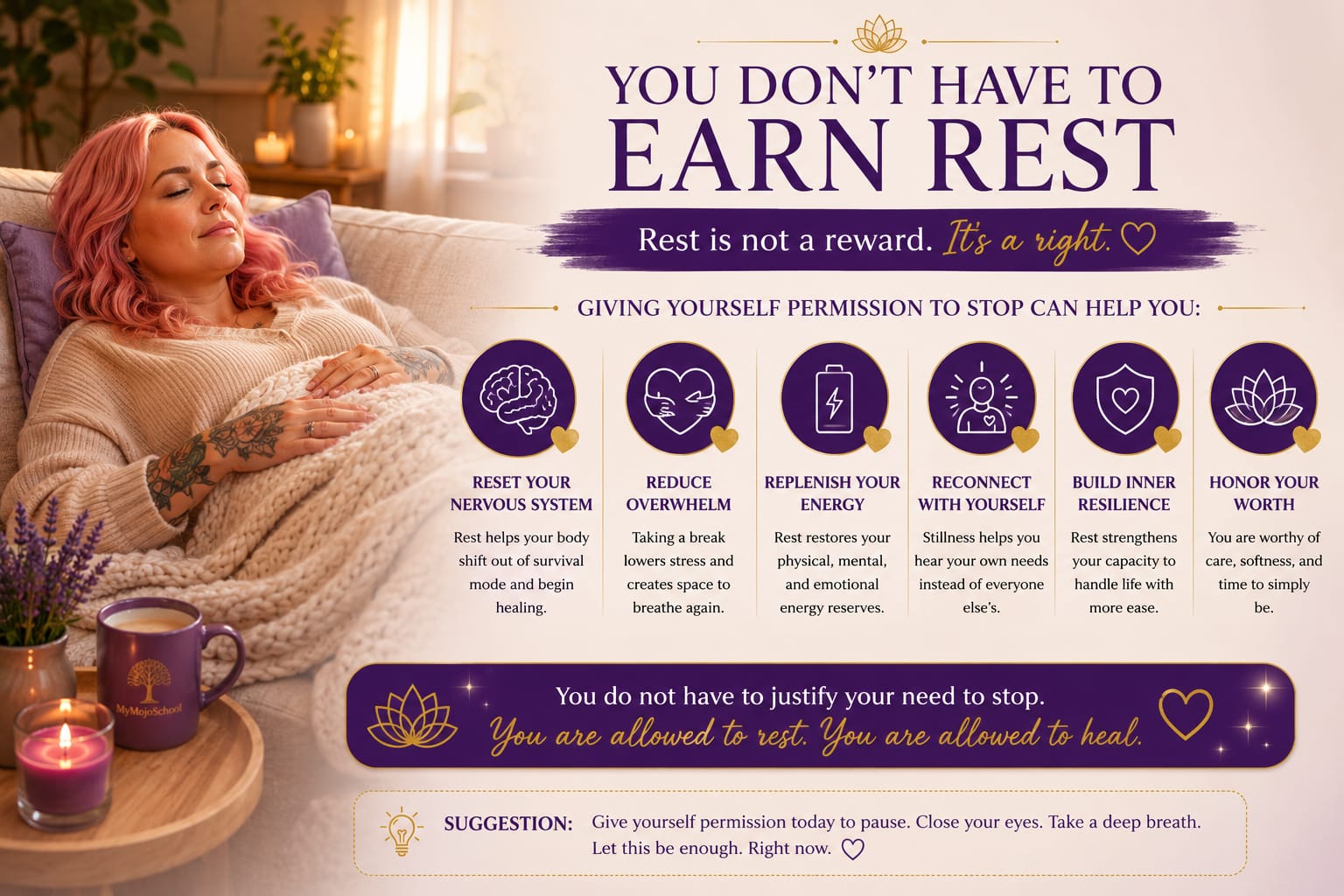
Perhaps the most important thing to say in an article about burnout recovery — and the thing that’s least likely to be said anywhere else:
You are allowed to be tired. You are allowed to need help. You are allowed to stop before you completely fall apart.
Rest is not a reward for productivity. It is not something you earn. It is something you deserve — simply because you are human, and because your wellbeing matters.
How MyMojoSchool Supports Women Through Burnout Recovery
At MyMojoSchool, we’ve built our entire platform around the understanding that emotional recovery requires more than information. It requires a space where you feel genuinely seen, supported, and guided by someone who understands the depth of what you’re navigating.
Our founder Jane Bellis brings personal and professional experience to every resource, course, and coaching offering — blending emotional intelligence with practical tools, and psychological insight with genuine warmth.
Whether you’re in the early stages of acknowledging your burnout, or further along in your recovery and ready to do the deeper transformational work, there is support here for you.
Frequently Asked Questions About Burnout Recovery for Women
How long does burnout recovery take?
Burnout recovery is genuinely individual and depends on the severity and duration of the burnout, the presence of support, and whether underlying patterns are being addressed. Mild to moderate burnout may show significant improvement within 3–6 months with the right support. More severe or long-standing burnout can take a year or more. The most important thing is not the timeline — it’s the consistency of care you give yourself during the process.
Can you recover from burnout without leaving your job?
Sometimes, yes. But only if the conditions contributing to the burnout can be changed meaningfully. For some women, recovery means setting boundaries, reducing hours, delegating responsibilities, or changing how they relate to work. For others, leaving or changing roles may become necessary. The key is not whether you stay or leave — it is whether your nervous system is given a real chance to recover.
What is the difference between burnout and exhaustion?
Exhaustion usually improves with rest. Burnout is deeper and more systemic. It affects your emotional regulation, motivation, nervous system, sense of identity, physical health, and capacity to feel connected to your life.
Is emotional numbness a sign of burnout?
Yes. Emotional numbness is one of the most common but least recognised signs of burnout. It often appears when your system has been overloaded for too long and begins protecting you by reducing emotional intensity.
What helps women recover from burnout?
Burnout recovery usually requires rest, nervous system regulation, emotional processing, boundary work, practical support, and deeper reflection on the patterns that led to burnout. Recovery is not just about doing less. It is about rebuilding a life that no longer demands your constant depletion.
Final Reflection
Burnout recovery for women is not about becoming productive again as quickly as possible. It is about becoming emotionally healthy enough that burnout no longer becomes your normal.
You are not broken. You are depleted. And depletion can be met with care, structure, compassion, and the right kind of support.
Ready to Begin Your Burnout Recovery?
Explore MyMojoSchool’s emotional healing and burnout recovery support for women who are ready to feel calmer, clearer, and more connected to themselves again.
Explore Courses