

How to Stop Overthinking: A Practical Guide for Women Who Cannot Switch Off
It starts before you have even opened your eyes in the morning.
Did I say the wrong thing in that meeting yesterday? Why has she not replied to my message? What if I made the wrong decision? Should I have handled that differently?
By the time you have made your first cup of tea, your mind has already run through six conversations, three worst-case scenarios, and a detailed post-mortem of something that happened three weeks ago.
If this is familiar, you are not broken, anxious by nature, or too sensitive. You are caught in one of the most common and most misunderstood mental patterns that women experience — and the science behind it is more straightforward than most people realise.
This guide covers why women are more prone to overthinking, what overthinking is actually doing for you, and a structured 5-step daily routine to interrupt and eventually rewire the pattern — not just manage it.

Why Women Overthink More — The Science of Rumination
Overthinking has a clinical name: rumination. It refers to the habit of repeatedly dwelling on negative thoughts, problems, past events, or potential future threats in a way that does not lead to solutions — it simply loops.
Psychologist Dr Susan Nolen-Hoeksema, whose research on gender and overthinking is among the most cited in the field, found that women are significantly more likely than men to engage in ruminative thinking — and that more than half of the women in her studies reported overthinking at levels that were causing meaningful distress.
The reasons behind this are not simply psychological. They are structural, social, and neurological:
- The emotional labour effect: Women are socialised to monitor the emotional states of everyone around them — partners, children, colleagues, friends. This constant scanning trains the brain to stay on alert, even when there is no immediate threat to respond to.
- The approval-seeking loop: Research consistently shows women face higher social penalties for assertiveness and directness. This creates a learned pattern of pre-analysing interactions — rehearsing what to say, replaying what was said — as a form of self-protection.
- Hormonal influence: Fluctuations in oestrogen and progesterone across the menstrual cycle directly affect serotonin and dopamine levels, which influence mood regulation and the brain’s tendency toward negative thought patterns.
- The default mode network: Brain imaging research shows that women’s default mode networks — the brain regions active during self-referential thinking — are more strongly connected, making inward-focused rumination more neurologically natural.
Jane explains more about the connection between anxious thinking and learned emotional patterns in this short video.
What Overthinking Is Actually Protecting You From
Here is something that most articles on overthinking skip entirely — and it is the piece that makes the biggest difference to actually changing the pattern.
Overthinking has a function. Your brain did not develop this habit randomly. It developed it because, at some point, it helped you avoid something painful — rejection, failure, conflict, embarrassment, being caught off guard.
Replaying a difficult conversation feels useful because it tells your brain you are preparing — making sure you never make the same mistake again. Imagining worst-case scenarios feels useful because your brain is trying to protect you from being blindsided.
The problem is not the impulse to protect yourself. The problem is that the protection has become disproportionate. The threat alarm is triggering for situations that are not actually dangerous — an ambiguous text message, a decision that has already been made, a comment that has already been said.
This is why simply telling yourself to stop thinking about it almost never works. You are fighting a protective mechanism without first addressing what it is protecting you from. The more effective approach is to work with the function, not against it.
Productive Thinking vs Overthinking — How to Tell the Difference
Not all repeated thinking is overthinking. Useful reflection, planning, and problem-solving all involve thinking things through more than once. The distinction is in the outcome:
| Productive Thinking | Overthinking |
|---|---|
| Leads to a decision or next step | Loops without reaching resolution |
| Feels like clarity building | Feels like anxiety building |
| Stops naturally once resolved | Continues even when the problem is “solved” |
| Based on what you can control | Focused on what you cannot control |
| Reduces uncertainty over time | Generates more uncertainty |
When you are in productive thinking, you feel movement — even if slow. When you are in overthinking, you feel the same ground moving under you repeatedly with no forward progress. Learning to notice this difference in the moment is one of the most practical skills you can develop.
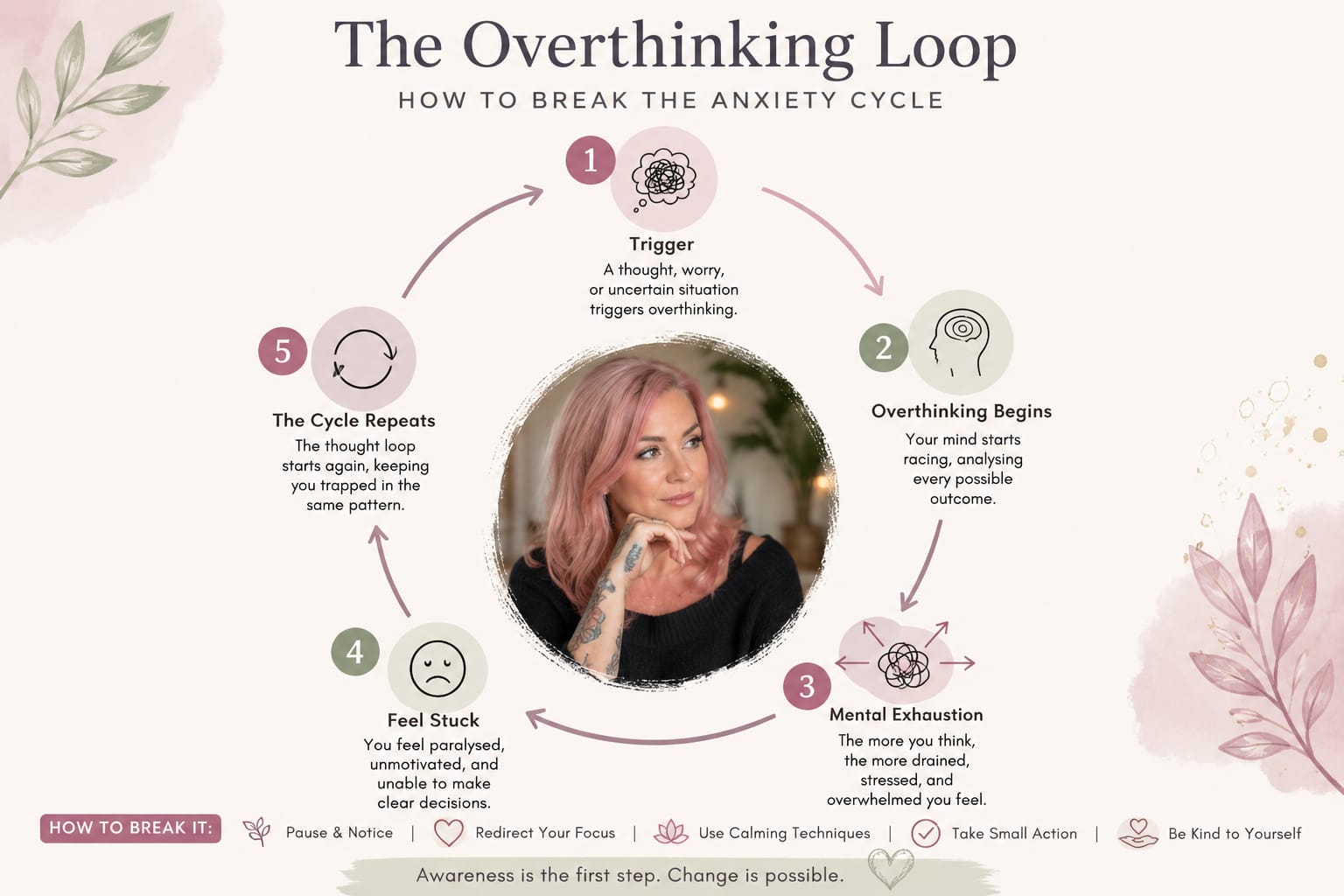
The 5-Step Daily Routine to Interrupt and Rewire Overthinking
What follows is not a list of tips. It is a structured sequence — a daily routine designed to work at two levels simultaneously: interrupting overthinking in the moment, and gradually rewiring the neural pathways that make it your brain’s default response.
The routine takes approximately 15 to 20 minutes across the day. It does not require setting aside a block of time. Each step fits into moments that already exist in your day.
Morning: The 90-Second Thought Check-In
Before reaching for your phone in the morning, spend 90 seconds noticing what your mind is already doing. Are you replaying yesterday? Planning a difficult conversation? Scanning for problems? Just notice — without trying to stop or change anything. This builds the meta-awareness that is the foundation of everything else. You cannot interrupt a pattern you cannot yet see.
When It Starts: The Pattern Interrupt
When you catch yourself in an overthinking loop, use grounding to interrupt it. Name 5 things you can see, 4 you can touch, 3 you can hear, 2 you can smell, and 1 you can taste. This works because grounding activates your sensory cortex, which competes directly with the default mode network driving the rumination. It is a neurological interrupt, not a distraction.
Midday: The Useful vs Useless Question
Once during the day, ask yourself this single question about any thought that is taking up space: “Is this thinking moving me toward a solution, or just keeping me in the problem?” If the answer is the latter, give the thought a closing statement: “I have noticed this. There is nothing to solve here right now.”
Evening: The Written Download
At the end of the day, spend exactly five minutes writing down everything your mind is still holding — not to process it, simply to externalise it. The act of writing physically transfers the holding function from your brain to the page.
Before Sleep: The Permission Statement
As you get into bed, say this aloud or in your head: “I have done what I can do today. My mind is allowed to rest.” This sounds simple — but spoken permission is a powerful signal to a nervous system that has been on high alert.
If you would like a guided walkthrough of these calming techniques, Jane shares practical mindset tools in this short video.
Techniques That Work vs Techniques That Waste Your Time
Not everything recommended for overthinking is equally effective. Some approaches are genuinely helpful. Others are well-intentioned but actually reinforce the pattern they are trying to break.
| Does Work | Why It Works | Does Not Work As Well | Why It Backfires |
|---|---|---|---|
| Written brain dump | Externalises the mental load off your brain | Talking about it repeatedly without resolution | Reinforces the loop without moving through it |
| 5-4-3-2-1 grounding | Activates sensory cortex, interrupts rumination | Telling yourself to stop thinking about it | Increases thought frequency — the rebound effect |
| Scheduled worry time | Contains rumination to a defined daily window | Positive affirmations alone | Does not address the function of overthinking |
| Physical movement | Releases cortisol, shifts nervous system state | Distraction without acknowledgement | Provides temporary relief but no lasting change |
| Mindful labelling: “I notice I am overthinking” | Creates helpful distance from the thought | Analysing why you overthink for too long | Becomes its own form of overthinking |
How to Build a Quieter Mind Over Time — Not Just in the Moment
In-the-moment techniques interrupt individual spirals. But building a genuinely quieter mind over time requires a gradual shift in how your brain evaluates safety and threat.
This happens through consistent practice across three areas:
- Nervous system regulation: A chronically activated nervous system will default to scanning for problems regardless of what thought-management tools you use. Daily practices that move your nervous system out of high-alert mode — slow breathing, physical movement, adequate sleep, reduced stimulant intake — create the physiological conditions for calmer thinking.
- Emotional processing: Overthinking is often a substitute for feeling. When an emotion feels too large or too unsafe to sit with, the mind stays in analysis rather than moving through the feeling.
- Inner trust: Much overthinking comes from a deep uncertainty about one’s own judgement. As women develop a more grounded relationship with their own perceptions, values, and decisions, the need to endlessly verify and re-verify through rumination naturally decreases.
The long game: The 5-step daily routine above addresses the symptom. Emotional processing and inner trust development address the root. Both matter. The routine gives you relief now. The deeper work creates lasting change.

When Overthinking Is a Sign of Something Deeper
For most women, overthinking is a learned habit that can be interrupted and reshaped with the right tools and consistent practice.
For some women, however, persistent and intrusive overthinking may be connected to underlying anxiety, OCD, PTSD, or depression. Signs that suggest professional support would be beneficial include:
- The overthinking is significantly interfering with your ability to work, maintain relationships, or complete daily tasks.
- You are experiencing intrusive thoughts that feel violent, disturbing, or completely out of character.
- The pattern has been present and worsening over a period of months or years without improvement.
- You are using alcohol, food, or other substances to quiet the mental noise.
- You feel genuinely unable to experience periods of mental quiet, even with structured attempts.
If any of these apply, please speak with your GP or a qualified mental health professional. Structured therapeutic support — particularly Cognitive Behavioral Therapy and Metacognitive Therapy — has a strong evidence base for treating clinical-level rumination. Reaching out for support is not failure. It is the most practical step you can take.
Frequently asked questions
Why do women overthink more than men?
Is overthinking a mental health condition?
What is the fastest way to stop overthinking in the moment?
Can overthinking be stopped completely?
How long does it take to stop overthinking?
Are there online courses for women that help with overthinking?