
What Happened When I Finally Stopped Pushing Through Burnout — And What Actually Helped
Not the polished version. The honest one. What the first week felt like, what made it worse, what surprised me, and — after months of structured recovery — what actually changed. This is the account most burnout articles never give you.
Accredited by: CPD Group · CMA · IPHM
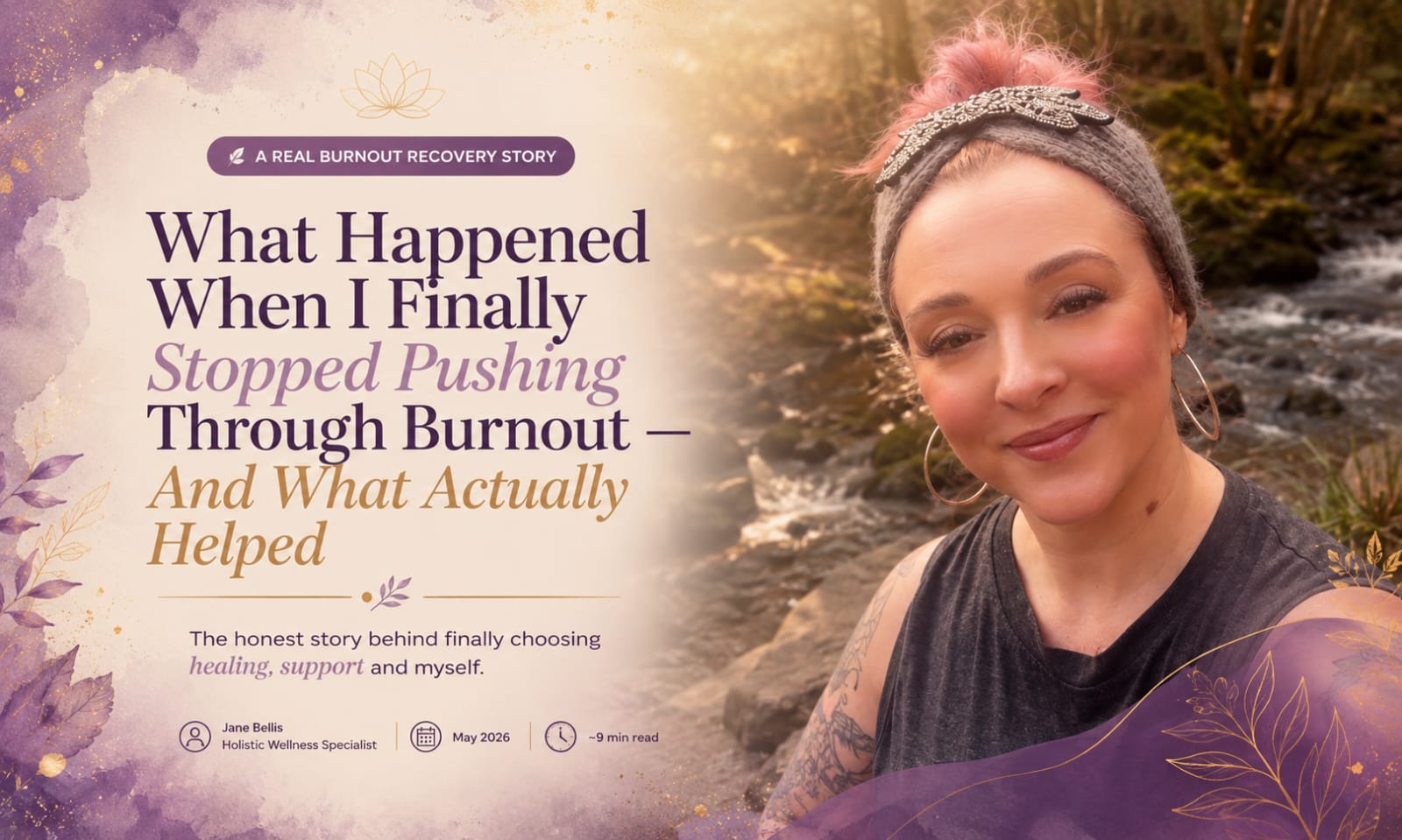
This article is written in first person — but it is not just one story. It is a composite of the experiences shared by hundreds of women who have come through burnout, many of whom have gone through the MyMojoSchool recovery process. The details are real. The timeline is real. The things that helped and the things that did not — all real. It is written this way because most burnout content describes recovery in the abstract. This one describes it from the inside — the way it actually feels when you stop, when you get worse before you get better, and when something finally begins to shift.
The Moment of Stopping — What It Actually Felt Like
The moment of stopping rarely looks like the dramatic breakdown that burnout content describes. For most women, it is quieter and more ambiguous than that. It is a Tuesday morning where something in you simply refuses to continue at the pace you have been maintaining. Not dramatically. Just — no. Not today. Not like this.
For some it is a health crisis that forces the stop. For others it is a conversation, or a realisation, or a moment alone where the gap between how they appear and how they actually feel becomes impossible to ignore any longer. The form varies. What is consistent is the feeling underneath: a combination of exhaustion so deep it has become structural, and a quiet knowing that something has to change.
And then comes the first unexpected thing about stopping: guilt. Not relief — guilt. The kind that arrives almost immediately and says, in a voice that sounds disturbingly like your own: other people are managing, why can't you? You don't have it that bad. This is self-indulgent. What will people think?
That guilt is not a signal that stopping is wrong. It is a symptom of the same conditioning that produced the burnout. The nervous system has learned that rest is dangerous — that slowing down means falling behind, disappointing people, losing status or control. Feeling guilty about stopping is not evidence that you should not stop. It is evidence of how necessary stopping actually is.
If you are at the moment of stopping — or contemplating it — and the guilt is loud and the fear of what happens next is real: this is the moment that most women who have fully recovered later identify as the most important one. Not the recovery itself. The decision to begin it. That decision, made from depletion and uncertainty and guilt, is the bravest thing. And it is enough.
The First Week — Why It Got Worse Before It Got Better
This is the section that almost nobody writes about — and the omission causes real harm. Because when women stop pushing through burnout and immediately feel worse, they assume they have made a mistake. They reassume the previous pace because it at least felt productive. And recovery stops before it has started.
Here is the truth: feeling worse in the first week of genuine rest is not a sign that recovery is not working. It is a sign that recovery has begun.
1–3
The crash — what the body does when you finally stop
When the pressure lifts, the adrenal system — which has been compensating for depletion through elevated stress hormones — begins to recalibrate. Cortisol drops. Adrenaline drops. And without those compensatory hormones, everything the body was using them to mask surfaces at once.
This means: profound fatigue that is unlike anything you have felt while pushing through. A heaviness that makes getting off the sofa feel like an enormous act. Possible low mood, tearfulness, a sense that things are worse than you thought. Possibly physical illness — the immune system, which was being suppressed by chronic cortisol, begins to process what it has been holding.
1–2
The guilt loop — the mind fights rest harder than the body does
The body is beginning to crash. The mind is generating an extraordinary volume of reasons why you should be doing something productive. Every moment of rest produces a commentary: you are wasting time, you are being weak, everyone else is keeping going, you will never catch up.
This is not willpower failing. This is a nervous system in chronic sympathetic dominance generating threat signals about rest — because it has learned that rest is unsafe. The commentary is the symptom. It is not true information.
2–4
The emotional surfacing — what rest allows to come up
As the nervous system begins to come out of high-alert — slowly, with consistent regulation practices — the emotions that have been suppressed begin to surface. This can look like unexpected crying, anger that arrives without obvious cause, grief for things you cannot quite name.
This is not a deterioration. It is the emotional processing layer of recovery beginning. The feelings were always there — they were just inaccessible while the nervous system was in survival mode. Their surfacing is a sign that the system is becoming safe enough to feel again.
1–2
The first glimmers — small moments of genuine restoration
Somewhere between week four and week eight, if the nervous system regulation practices are being done consistently, something begins to shift. It is not dramatic. It is a morning where you wake up and notice — just for a moment — that the heaviness is slightly less. A walk where you notice the light and feel something instead of nothing. A conversation where you are genuinely present rather than performing presence.
These moments are small. They matter enormously. They are the first evidence that the nervous system is beginning to recalibrate — and they are what keep you going through the next phase.
2–4
Active recovery — when the structured work becomes meaningful
By this stage, the nervous system has begun to stabilise sufficiently that the other layers of recovery become accessible. Boundaries that felt impossible to set begin to feel possible. Emotional processing practices that felt too overwhelming in week one can now be engaged with. The identity and values work — who am I outside of my roles and my productivity — begins to have answers rather than silence.
4+
Integration — building a life that does not produce the same outcome
Full recovery is not a destination that arrives and stays permanently. It is a practice of ongoing monitoring, maintenance, and conscious choice. The sustainable rhythm work — daily recovery anchors, weekly space, monthly review — becomes the architecture that prevents relapse. Not through vigilance, but through genuine structural change in how you live.
"One of the most important things I tell patients beginning burnout recovery is this: the first two to four weeks are often the hardest, not the easiest. When the body finally stops compensating through stress hormones, it has to process what it has been holding. This phase is not regression — it is the beginning of genuine recovery. Understanding this in advance is the difference between continuing through it and giving up at the moment it is most important to continue."
What Actually Helped — And What Did Not
This is the section that cuts through the noise. Not what the articles said would help. What actually changed things — and what produced temporary relief without lasting recovery.
Five minutes of inhale for 4 counts, exhale for 6–8 counts. Done before reaching for a phone, before the day's demands, before anything. This was the single most consistently effective practice across everyone's experience. Not because it is dramatic — it is not — but because done every morning for six weeks it genuinely begins to recalibrate the nervous system. The waking dread reduces. Sleep begins to deepen. The baseline shifts, slowly but measurably.
Not "I will set better boundaries" or "I need to reduce my workload." One specific thing that was removed, redistributed, or ended. For some women it was a commitment that was dropped. For others it was a conversation about domestic redistribution that had been avoided for months. For others it was removing the expectation that they were available by phone after 7pm. The specificity is what made it work. Intentions without concrete action do not change the conditions that produced burnout.
The distinction matters. Exercise — particularly high-intensity exercise — further activates the sympathetic nervous system and can worsen burnout in its acute stages. Slow, rhythmic, gentle movement — walking without a destination or timeframe, gentle swimming, yin yoga — moves stored stress hormones through the body and activates the parasympathetic system. Many women pushed into intense exercise as their burnout recovery strategy and found it made things worse. Slow movement was the opposite experience.
Not reflective journalling. Not gratitude lists. Raw, unfiltered writing about what was actually being felt — the anger, the grief, the resentment, the fear. Without editing, without reading back, without trying to reach insight. The purpose was externalisation — moving the emotional content from inside to outside. This was the practice most women were most resistant to, and the one that most consistently produced a feeling of lightening when it was actually done.
Felt better during. Returned to the same conditions. Felt worse within two weeks. The holiday removed the woman from the burnout-producing conditions temporarily — it did not change those conditions. Coming back felt worse than before because the brief window of relief had made the contrast sharper. A holiday is a temporary pause on burnout production, not a recovery intervention.
Many women used intense cardio or gym sessions as their primary stress outlet — and found that in burnout it stopped working, or made them feel worse. This is neurologically predictable: high-intensity exercise activates the sympathetic nervous system (the same system that is already chronically overactivated in burnout). What the depleted nervous system needs is not more activation — it needs downregulation. Slow movement does this. HIIT does the opposite.
The most common advice. The least effective intervention for burnout specifically. Not because mindset does not matter, but because the autonomic nervous system does not respond to cognitive reframing. You can think your way to an accurate understanding of burnout without your body having any interest in your revised perspective. The nervous system responds to embodied practice — not to thought. Reframing helped some women feel temporarily less guilty. It did not change their physiological state.
The Turning Point — When Something Finally Shifted
The turning point in burnout recovery is rarely a single dramatic moment. It is usually a quiet accumulation — weeks of consistent practice producing something that cannot be pointed to as a specific event, but that can be felt as a genuine shift in baseline.
The clearest signal, reported consistently across women who have moved through burnout recovery, is this: the first morning you wake up and do not immediately dread the day. Not euphoria. Not energy. Just — absence of dread. After months of waking up in low-level anxiety about what the day requires, a morning where the waking state is neutral feels extraordinary.
That shift — from chronic low-level dread to neutral — is the turning point. It comes from consistent nervous system regulation practice, from at least one structural condition having changed, from some emotional processing having occurred. It is not permanent immediately — it will waver. But once it has appeared, it confirms that the system is genuinely recalibrating, not just managing.
"Recognition of the need for self-care — genuine recognition, not intellectual acknowledgement — is empirically confirmed as the first step toward restoring balance in burnout recovery. What distinguishes women who achieve lasting recovery from those who cycle back into burnout is the development of what researchers call somatic self-awareness: the ability to recognise and respond to the body's signals before they escalate to crisis level. This is a learnable skill, not an innate trait — and structured intervention is significantly more effective at developing it than self-directed effort alone."
5 Things I Wish I Had Known Before I Started Recovery
Getting worse before getting better is part of recovery, not evidence against it
The first two to four weeks of genuine rest often feel worse than continuing to push through. This is the adrenal system recalibrating, the nervous system beginning to process what it has been holding, the immune system catching up. If nobody tells you this in advance, you stop at exactly the point you need to continue. This knowledge is the difference between recovery and another failed attempt.
The nervous system comes first — everything else depends on it
Boundaries, emotional processing, identity work — all of these are significantly harder to access when the nervous system is in chronic high-alert. Trying to set boundaries before the nervous system has begun to regulate is why boundaries feel impossible in burnout. The sequence matters: nervous system regulation first, then everything else in the recovery framework.
One real structural change matters more than ten new habits
New habits — breathing exercises, journalling, walks — address the individual's response to the conditions. One real structural change — a commitment dropped, a domestic responsibility redistributed, an availability boundary actually held — reduces the conditions themselves. Habits alone cannot recover a person who is still living in the conditions that produced the burnout. One structural change, done genuinely, outweighs ten new wellness practices.
Recovery is not linear — setbacks are part of the process, not evidence of failure
There will be weeks that feel like regression after weeks that felt like progress. This is the expected pattern, not the exception. The nervous system does not recalibrate in a straight line. A difficult week in month three does not mean recovery is not happening — it means recovery is happening in the non-linear way that it always does. The women who reach full recovery are not the ones who never had setbacks. They are the ones who did not interpret setbacks as evidence that recovery was not possible.
The goal is not getting back to who you were — it is building something more honest
The version of you that burned out was functioning at an unsustainable level, often disconnected from her genuine needs and values. The goal of recovery is not to restore that version. It is to build a version who knows what she actually needs, gives it to herself most of the time, and has a daily structure that generates enough recovery to sustain whatever she chooses to do. That is not going back. That is going somewhere genuinely better.
Where Recovery Actually Leads
The most honest thing to say about where burnout recovery leads is this: it does not lead back. It leads forward — to something different from where you started, built on a more accurate understanding of what you need and what you can sustainably carry.
The women who have moved through full burnout recovery — through all five layers, with appropriate support — consistently describe the experience not as a return to their previous selves, but as a more honest version of themselves. Someone who knows what depletes her and mostly responds before it accumulates. Someone who has reduced the gap between how she appears externally and how she actually feels internally. Someone who has rebuilt a sense of identity that does not depend entirely on what she produces or how well she meets everyone else's needs.
That is not a small thing. For women who spent years operating with a significant gap between external performance and internal experience, it is, in fact, everything.
If you are at the beginning of this — at the moment of stopping, or contemplating it, or just recognising that something has to change — the path described here is available to you. The MyMojoSchool Burnout Recovery Programme walks through every stage of this process in a structured, sequenced format built specifically for women. The free guides — Phase 1, Phase 2, Phase 3 — are the place to start.
| Where you are now | Your next step |
|---|---|
| Still pushing through, wondering if it is burnout | Understanding Burnout — Phase 1 — the 5 stages and self-check quiz |
| Ready to stop but scared of what happens | Read this article again. What happened when others stopped is what will happen for you too — including the getting worse before better. Now you are prepared. |
| In early recovery and feeling worse | This is expected. It is the sign that recovery has started. The Recovery Plan gives you the full framework including what to do in this phase. |
| Stuck mid-recovery with no progress | I've Tried Everything and Nothing Works — the 5 missing layers that explain why stalling happens |
| Ready for structured guided support | The MyMojoSchool Burnout Recovery Programme — all five layers, guided, self-paced, built for women |
Frequently Asked Questions
The honest answer is that most women who are genuinely ready to stop already know. The question "am I ready?" is often less about readiness and more about permission. If you are asking this question, something in you has already decided. The more useful question is: what is the first concrete step? For most women, the first step is not stopping everything — it is stopping one thing, or starting one small recovery practice consistently, and seeing what that reveals. The Understanding Burnout guide helps identify your stage and what the appropriate first step looks like at that stage.
This is a real constraint that most burnout content ignores. Very few women have the option to simply stop working for three months. The recovery framework described here is designed to work alongside continued responsibilities — not to require complete withdrawal. The sequenced approach starts with nervous system regulation (five minutes daily, compatible with any schedule), moves to structural changes within your current life (not radical redesign), and builds from there. Recovery while working is possible at Stage 2–3 burnout with genuine, consistent application of the framework. For Stage 4 burnout, some reduction in professional load — even temporary, even partial — significantly affects recovery speed. The specifics are in the Recovery Plan.
No — unless there is a genuine safety or clinical concern that requires professional assessment. Feeling worse in the first two to four weeks of genuine rest is the expected experience of burnout recovery, not a sign that it is not working. The adrenal system recalibrates, the nervous system begins to process what it has been holding, and the immune system catches up with what it has been suppressing. This produces temporary increases in fatigue, emotional release, and sometimes physical illness. Returning to the previous routine at this point stops recovery at the moment it has just begun. If you are concerned about the severity of what you are experiencing, speak with your GP — but do not use feeling worse in week one as evidence that stopping was a mistake.
Reading about burnout recovery — including this article — produces understanding. Understanding is valuable. It is also insufficient on its own, for a specific reason: the nervous system does not respond to intellectual knowledge. It responds to embodied practice — consistent, repeated physical inputs done over time. The MyMojoSchool Burnout Recovery Programme provides the structured, sequenced, guided practice that moves knowledge into embodied change. It does not just tell you what to do — it walks you through doing it, in the right order, with the accountability and pacing that self-directed reading cannot provide. For most women, the gap between knowing what to do and actually doing it consistently is where recovery stalls. Structure closes that gap.
Probably not — and that is not a loss. The version of you that burned out was operating at an unsustainable level, often significantly disconnected from her genuine needs and values. Going back to that version would mean going back to the conditions that produced the burnout. What recovery leads to is not the previous version of yourself, but a more honest and sustainable one — someone with a clearer sense of what she actually needs, a lower tolerance for conditions that deplete her, and a daily structure that genuinely supports her wellbeing. Women who have completed full burnout recovery overwhelmingly describe this not as a diminished version of their previous life, but as a more genuine one. The Life After Burnout guide explores this in detail.
Ready to Begin Your Own Recovery Story?
The MyMojoSchool Burnout Recovery Programme gives you the structured, sequenced framework that turns understanding into embodied change — built specifically for women, at every stage of burnout.
Accredited by CPD Group · CMA · IPHM | Fully self-paced | Built for women at every stage
This article is written for informational and educational purposes only. It does not constitute medical or psychological advice. The experiences described are composite accounts drawn from women who have gone through burnout recovery — they are representative of common patterns, not a guaranteed individual timeline. If you are experiencing severe burnout, depression, or any clinical condition, please speak with a qualified healthcare professional.

OUR TOP RATED COURSES