
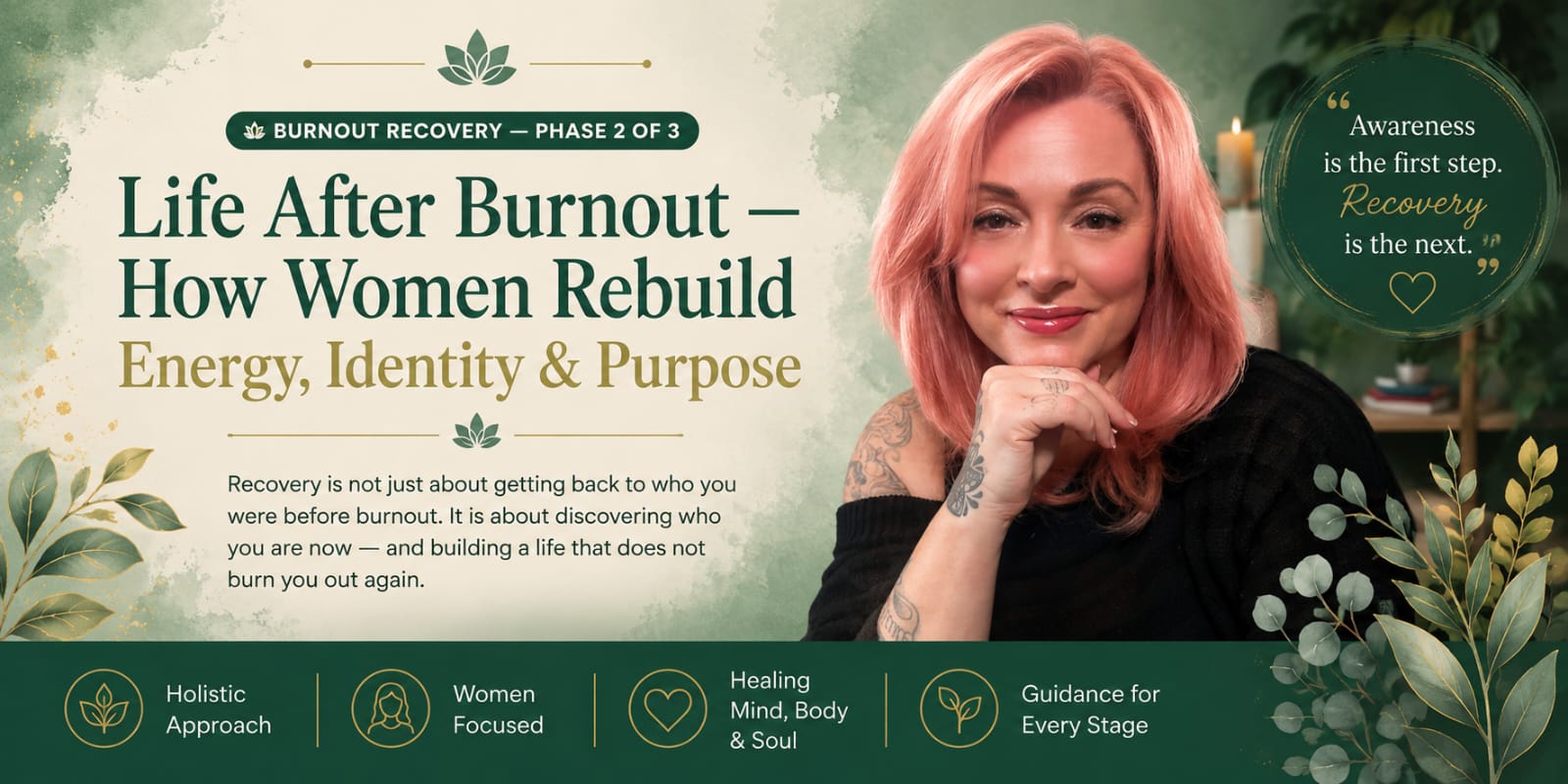
Life After Burnout — How Women Rebuild Energy, Identity & Purpose
Recovery is not just about getting back to who you were before burnout. It is about discovering who you are now — and building a life that does not burn you out again.
Accredited by: CPD Group · CMA · IPHM
Life after burnout for women involves rebuilding across three distinct tracks simultaneously: energy (restoring physical and nervous system vitality), identity (recovering the sense of self that burnout erodes), and purpose (reconnecting with what genuinely matters, beyond what is simply expected). Most recovery guides stop at energy alone. This page covers all three tracks — because full recovery requires all three, and because for most women, the identity and purpose dimensions of burnout are the most profound and the least supported.
Why "Getting Back to Normal" Is the Wrong Goal — And What to Aim for Instead
Q: What does life after burnout look like for women?
A: Life after burnout for women is not a return to the pre-burnout baseline. Research on post-burnout recovery indicates that women who attempt to simply resume their previous pace and structure typically relapse within 6–12 months. Genuine post-burnout life involves three parallel rebuilding processes: restoring energy through sustainable nervous system regulation, recovering a sense of identity that does not depend solely on performance or caregiving roles, and rediscovering purpose that is rooted in personal values rather than external expectation. For most women, burnout creates an involuntary but significant life review — an opportunity to build differently, not just recover the same structure.
The most common mistake women make when they begin to feel better after burnout is trying to get back to who they were before it happened. This feels logical — recovery means returning to your previous state. But it carries a critical flaw: your previous state is what produced the burnout.
This does not mean your previous life was wrong or that you failed to build it well. It means that the conditions — the pace, the load, the ratio of giving to receiving, the relationship between your external life and your internal needs — were not sustainable for the long term. Going back to them will produce the same outcome.
The research from White River Manor (2025) is direct on this point: the women who sustain recovery are those who use the burnout period not just as a recovery window, but as a fundamental review of how they want to live. Not in a grand, abstract sense. In the specific, practical sense of: what do I want more of? What do I need to stop? What do I value that I have been consistently neglecting?
If you are reading this in the middle of recovery and the idea of "rebuilding differently" feels overwhelming — please hear this: you do not have to figure it all out now. Phase 3 does not begin the day you start feeling better. It begins when you have enough stability in your nervous system and enough energy to hold a bigger question. That timing is different for everyone. There is no rush.
The Three Rebuilding Tracks — Why All Three Matter
Post-burnout rebuilding for women happens across three distinct tracks. Most recovery content addresses only the first. All three are required for full, lasting recovery.
Energy restoration is about more than rest. It is about building a daily and weekly rhythm that generates consistent recovery — so that your body and nervous system are no longer operating in a permanent deficit. This track is the most visible and the one most plans address.
Burnout strips identity. The woman who arrives at Stage 4 or 5 burnout has typically lost connection with who she is outside of her roles — mother, professional, partner, carer, achiever. Identity recovery is the process of finding that again — not the same version, but a version grounded in who you actually are now.
Purpose is not a grand life mission. It is the daily sense that what you are doing connects to something you genuinely care about. Burnout severs this connection — often because the work or life that burnt you out was driven more by obligation than by genuine meaning. Rediscovering purpose after burnout is about finding that connection again, on your own terms.
Rebuilding Energy Sustainably — Beyond Rest and Into Rhythm
By the time you reach Phase 3, you have done the foundational recovery work. Your nervous system is more regulated. Your sleep is improving. The acute depletion has lifted. Now the energy work shifts from survival-level recovery to building a sustainable architecture — one that generates energy consistently rather than just preventing further collapse.
Morning Regulation Anchor
The first 20 minutes of your day set the nervous system tone for everything that follows. Protect them. No phone, no news, no immediate demands. Extended exhale breathing, gentle movement, or simply sitting with a warm drink in silence. This is not indulgence. It is nervous system architecture.
Energy Accounting — Not Time Management
Post-burnout, the traditional productivity model — manage your time, do more — actively works against recovery. Replace it with energy accounting: track what gives you energy and what drains it, and deliberately build more of the former into your week. This is the only productivity system that is compatible with burnout recovery.
The Strategic No
In Phase 3, every yes costs energy you are still rebuilding. Before agreeing to any new commitment — social, professional, domestic — apply one question: does this add to my energy or subtract from it? If the honest answer is the latter, the default is no. This is not permanent. It is appropriate to where you are.
Restorative Activities — Not Just Rest
Beyond rest, actively building restorative activities — things that return more energy than they cost — is essential. These are individual. For some women it is time in nature, creative work, reading, cooking, or gentle exercise. Identify yours specifically and protect time for them weekly, not when you "have time."
The Monthly Energy Review
Once per month, spend 15 minutes reviewing: what depleted me most this month? What restored me most? Is my current ratio sustainable? This simple practice is one of the most powerful burnout-prevention tools available — and almost no one uses it consistently.
"The research on energy and performance shows consistently that what we call 'rest' is not passive. The nervous system requires active recovery inputs — movement, social safety, creative engagement, nature exposure — not just the absence of demand. Women in post-burnout recovery who build these active recovery inputs into their daily structure recover measurably faster and sustain that recovery longer than those who simply reduce demands without replacing them with restorative inputs."
Recovering Your Identity After Burnout — The 5 Stages No One Names
Identity loss is one of the most distressing and least discussed dimensions of burnout for women. The question "Who am I now?" is not a philosophical indulgence. It is a genuine psychological consequence of burnout — and it deserves a proper, honest answer.
Q: Why does burnout cause identity loss in women?
A: Burnout causes identity loss in women because many women's sense of self is closely tied to their roles and their capacity to perform those roles effectively. When burnout reduces that capacity — making them less productive, less emotionally available, less able to meet expectations — the identity built on those capacities collapses alongside it. Research in occupational psychology identifies this as role-based identity erosion: when the role is disrupted, the self that was built around it becomes uncertain. For women, this is compounded by the fact that burnout often simultaneously affects multiple roles — professional, parental, relational — leaving very little stable identity ground. Recovery requires rebuilding a sense of self that is not contingent on role performance.
Here are the five stages of post-burnout identity loss that most women move through — named here because naming them is itself a form of relief:
Disillusionment — The Roles No Longer Feel Like You
The work, relationships, or responsibilities that once felt meaningful begin to feel hollow or foreign. You show up, but you feel like an impersonator of yourself. The roles remain but the felt connection to them disappears.
"I used to love this. Now I just feel nothing when I do it."Detachment — Emotional Distance From Yourself
You begin to feel detached not just from your roles but from yourself — watching your life from a slight distance, going through motions without genuine engagement. This is a nervous system protection response, not a character trait.
"I feel like I am watching my life rather than living it."The Identity Void — Not Knowing Who You Are
The most disorienting stage. Without the roles and performance that previously anchored identity, a genuine void opens. Who am I if I am not achieving? Who am I if I am not needed? This void is uncomfortable — but it is also the space in which genuine identity can be rebuilt.
"I genuinely do not know who I am anymore."Tentative Emergence — Glimpses of Who You Are Beneath the Roles
As nervous system regulation improves and the acute pressure lifts, glimpses appear — moments of genuine enjoyment, opinions that feel truly yours, preferences that emerge without reference to what others need or expect. These glimpses are not insignificant. They are the beginning of your rebuilt identity.
"I noticed I actually enjoyed that. That surprised me."Intentional Rebuilding — Choosing Who You Want to Be
The final stage is active and intentional. Not returning to the previous identity, but consciously building a new one — based on your values, your genuine preferences, and what you have learned about yourself through the burnout experience. This is the stage where burnout becomes, paradoxically, one of the most significant growth experiences of a woman's life.
"I am starting to know what I actually want — possibly for the first time."If you are in Stage 3 — the identity void — and it feels genuinely frightening, please know this is one of the most commonly experienced and least discussed dimensions of burnout recovery. You are not losing your mind. You are not permanently damaged. You are in the space between who you were built to be and who you actually are. That space is uncomfortable. It is also where change becomes possible.
"Identity is not a fixed entity that you either have or have lost. It is an ongoing construction — built through what you do, what you value, and how you relate to others. Post-burnout identity reconstruction is not about recovering a previous self. It is about building a more authentic self — one whose foundations are values and genuine engagement rather than performance and approval."
Rediscovering Purpose Without Pressure — A Different Kind of Why
Q: How do women find purpose after burnout?
A: Finding purpose after burnout requires a different approach from the pre-burnout drive for achievement and impact. Post-burnout purpose is typically quieter, more personal, and more values-aligned than the purpose that existed before. Key principles for rediscovering purpose after burnout: distinguish purpose from productivity (purpose is about meaning, not output), start with what energises rather than what impresses, allow purpose to be small and daily rather than grand and singular, reconnect with values through reflection rather than goal-setting, and give it time — purpose after burnout emerges gradually as energy and identity stabilise. Women who rush this process typically reattach to obligation-driven purpose, which risks reproducing the conditions of the original burnout.
The most common mistake in post-burnout purpose work is treating it like a productivity challenge — setting goals for meaning, making plans for passion, scheduling purpose into the diary. This reproduces exactly the pattern that generated burnout.
Post-burnout purpose emerges differently. It is quieter. It tends to show up in small moments — something you did that left you feeling more alive rather than more depleted. Something you said no to that felt, unexpectedly, like relief rather than failure. Something you care about that has nothing to do with what anyone else needs from you.
Here are the four domains where post-burnout purpose most commonly reveals itself:
The 5-Step Post-Burnout Rebuild Framework
This is the practical sequence for Phase 3 work — the steps that move you from recovery into intentional rebuilding. They are not linear. You will move between them. But they give you a structure to return to when you feel lost.
Most women skip this entirely and move straight to problem-solving. But there is real loss in burnout — lost time, lost relationships, lost versions of yourself, lost confidence, sometimes lost opportunities. Acknowledging this grief explicitly, rather than bypassing it with positivity, is what allows genuine forward movement.
This is different from "everything happens for a reason." It is a specific, practical question: what did you learn about yourself from this experience that you did not know before? About your limits, your values, what you can and cannot sustain, what matters and what does not. These are genuine learnings — earned at significant cost. Do not waste them.
Goals are about what you want to achieve. Values are about who you want to be and how you want to live. Post-burnout rebuilding starts with values, not goals. If you set goals before clarifying values, you risk rebuilding a different version of the same burnt-out life. Values mapping asks: what matters most to me — when nobody is watching, when there is no external reward, when I am at my most honest?
Rebuilding is not a single grand redesign. It is a sequence of small, values-aligned decisions made consistently over time. Each decision to say no to something that depletes you and yes to something that restores you is a brick in the rebuilt structure. This is slow work. It is also the only work that produces lasting change.
The final step is building the monitoring and prevention system that means burnout cannot creep back in unnoticed. This includes: the monthly energy review from Phase 2, a trusted person who will tell you honestly when you are sliding, clear personal warning signals that you now know from experience, and a committed relationship with your non-negotiable recovery practices even when life gets busy — especially when life gets busy.
Understanding and Preventing Burnout Relapse
Q: Is burnout relapse common in women?
A: Yes. Burnout relapse is significantly more common than primary burnout in many populations. Research indicates that women who recover from burnout without addressing the structural conditions that produced it — particularly around load distribution, boundary structures, and identity foundations — have a relapse rate estimated between 40–60% within 12–24 months. Relapse risk is highest when: recovery is rushed (returning to full capacity before the nervous system is fully regulated), the structural conditions are unchanged, the identity and purpose dimensions of recovery are skipped, and the monitoring and prevention practices established during recovery are abandoned when life becomes busy again.
Burnout relapse does not mean you failed at recovery. It means the conditions reasserted themselves faster than your recovery could hold against them. It is a systems problem, not a personal one — but it is one you can address.
| Relapse Risk Factor | Prevention Strategy |
|---|---|
| Resuming full pace before nervous system is stable | Stage-gate your return — increase load only when sustained stability is confirmed |
| Unchanged structural conditions | Identify and change at least one root condition — not just coping strategy |
| Skipping identity and purpose work | Complete all three tracks — not just energy restoration |
| Abandoning recovery practices when busy | Make 2–3 practices truly non-negotiable — especially when life accelerates |
| No monitoring system | Monthly energy review + trusted external observer who will give honest feedback |
| Guilt about protecting recovery | Reframe protection of recovery as professional and personal responsibility |
Phase 1 — Understanding your burnout. Phase 2 — Working through the recovery plan. Phase 3 — Rebuilding energy, identity and purpose. The next step is the MyMojoSchool Burnout Recovery Programme — a structured, guided version of everything covered across all three phases.
Frequently Asked Questions
You are ready to begin Phase 3 when: your nervous system feels more regulated on most days (not all), you have some capacity to hold a bigger question without it feeling overwhelming, your basic energy is returning — you can engage with daily life without it costing everything you have. You do not need to feel fully recovered. You need enough stability to hold the identity and purpose questions without them triggering a relapse into survival mode. If you are unsure, stay in Phase 2 work longer. There is no deadline.
Yes — and it is one of the least discussed aspects of the experience. Burnout involves real losses: time, energy, relationships, professional opportunities, versions of yourself that you invested in. Grieving these losses is not self-pity — it is an honest reckoning with what happened. Women who bypass this grief and move directly to positivity and rebuilding often find the grief resurfaces later, sometimes in the form of depression or a second burnout. Allowing the grief its place — actively, not indefinitely — is part of what makes genuine forward movement possible.
Not knowing your purpose after burnout is entirely normal — and it is actually the correct starting position. Purpose after burnout is not found through thinking or planning. It emerges through noticing: what activities leave you feeling more alive rather than more depleted? What do you find yourself drawn to when there is no external expectation shaping the choice? What would you do if no one was watching and nothing was required of you? These small observations, collected over weeks and months, build the picture of your post-burnout purpose. Do not rush the answer. The question itself is doing important work.
Yes — and research supports this, though it must be stated carefully. Burnout is not a gift or something to be grateful for as an experience. The cost is real and significant. However, the enforced review it creates — of how you have been living, what you have been prioritising, and what has been missing — is something many women describe as the most important self-discovery of their lives. The key distinction is between post-traumatic growth (genuine change that emerges from working through the experience) and toxic positivity (dismissing the cost by reframing everything as a blessing). The former is real and documented. The latter is harmful.
The MyMojoSchool Burnout Recovery Programme covers all three phases of recovery — understanding, recovery plan, and rebuilding — in a structured, self-paced format built specifically for women. Jane Bellis's approach addresses all three tracks: energy restoration, identity recovery, and purpose rebuilding. The programme is accredited by the CPD Group, the Complementary Medical Association (CMA), and the International Practitioners of Holistic Medicine (IPHM), and is designed to be completed at the pace your recovery requires — not at a fixed schedule that ignores where you actually are.
Ready to Rebuild — With Structure and Support?
The MyMojoSchool Burnout Recovery Programme guides you through all three phases — understanding, recovery, and rebuilding — in a self-paced format designed specifically for women.
Accredited by the CPD Group · CMA · IPHM | Self-paced | Built for every stage of burnout
Explore the Burnout Recovery Programme →This page is written for informational and educational purposes only. It does not constitute medical or psychological advice. If you are experiencing symptoms of severe burnout, depression, or any other mental health condition, please speak with a qualified healthcare professional. The content here is intended to support, not replace, clinical care.

Our top rated Courses