
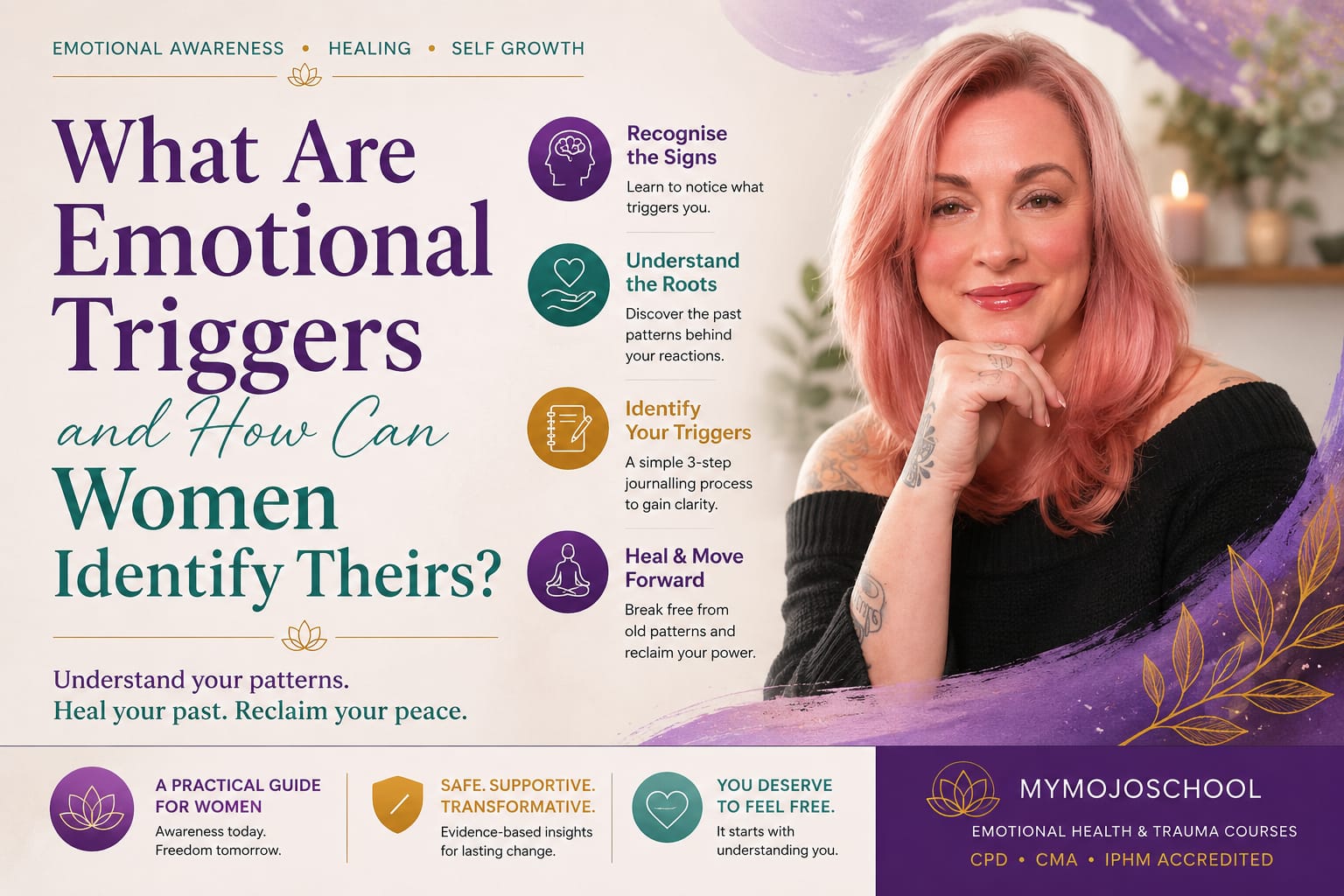
What Are Emotional Triggers and How Can Women Identify Theirs?
Something happens — a tone of voice, a message left on read, someone moving through a room without acknowledging you and suddenly you are not simply mildly annoyed. You are flooded. Your heart rate rises, your chest tightens, and a wave of emotion arrives that feels completely disproportionate to what just happened.
You might feel ashamed of the reaction. You might tell yourself you are overreacting. You might replay it for the rest of the day wondering what is wrong with you.
There is nothing wrong with you. What you are describing is an emotional trigger — and understanding it, rather than fighting it, is one of the most powerful steps you can take toward emotional freedom.
This guide explains what emotional triggers actually are, why women often carry more of them than they realise, and a practical 3-step process for identifying yours — so they stop running the show without your knowledge.

What an Emotional Trigger Actually Is — And What It Is Not
The word trigger has become common in everyday conversation, which is helpful in some ways and confusing in others. Before anything else, it is worth being clear about what an emotional trigger actually means.
An emotional trigger is a present-moment experience — a situation, a word, a tone, a look, a smell, a silence — that activates an emotional response rooted in a past experience. The intensity of the reaction belongs to the past, not the present. That is the defining feature.
A trigger is not:
- Simply disliking something. Not enjoying spicy food, loud music, or small talk is a preference — not a trigger.
- Reacting reasonably to something genuinely unkind. If someone speaks to you dismissively, feeling hurt is a proportionate response, not a trigger reaction.
- A permanent character flaw. Triggers are not personality — they are learned responses that can be understood and worked with.
A trigger is: a present experience that activates disproportionate emotion because it connects, consciously or unconsciously, to something painful or unresolved from earlier in your life.
The key word is disproportionate. If your emotional response feels bigger, longer-lasting, or harder to move through than the situation seems to warrant — that is a signal worth paying attention to.
According to Cleveland Clinic psychologist Dr Susan Albers, triggers cause reactions that are often disproportional to the actual event because they connect to unprocessed past experiences rather than the current moment alone.
Why Women Often Carry More Unprocessed Triggers Than They Realise
Emotional triggers come from experiences where our emotional needs were not met, where we felt unsafe, unseen, rejected, shamed, or overwhelmed — and where we did not have the tools, the support, or the space to fully process what we felt at the time.
Women, for a range of structural and social reasons, are more likely to accumulate unprocessed emotional experiences over a lifetime.
- Emotional suppression is socialised early. Girls are frequently taught, both directly and indirectly, to manage their emotions quietly — to be kind, to not make a fuss, to keep the peace. Emotions that cannot be expressed do not disappear. They wait.
- The caretaking role creates emotional backlog. When you are the person responsible for managing everyone else's emotional needs — a common experience for women in families, relationships, and workplaces — your own emotions are consistently deprioritised. Over years, this creates a significant backlog of unfelt feeling.
- People-pleasing delays emotional awareness. When your primary strategy for feeling safe is to make others comfortable, you become highly attuned to other people's emotional states and much less attuned to your own. Triggers can remain invisible for a long time when your attention is always directed outward.
- Shame makes triggers feel like character flaws. Many women carry shame about the intensity of their emotional reactions — which makes them less likely to examine the reactions with curiosity, and more likely to bury them further.
Trigger, Preference, or Ordinary Reaction? A Practical Distinction
One of the most useful things you can learn is how to tell a genuine trigger apart from a preference or a reasonable emotional response. Here is a simple way to think about it:
| Type | How It Feels | What It Tells You |
|---|---|---|
| Preference | Mild, consistent dislike. You avoid it when you can. | Personal taste — no healing required. |
| Ordinary reaction | Proportionate to what happened. Settles when the situation resolves. | You have normal emotional responses. |
| Trigger | Intense, sudden, feels bigger than the moment. Lingers or spirals. | Something from the past is asking for attention. |
The speed and intensity of the emotional response is often the clearest indicator. A trigger tends to arrive fast and feel bigger than the room. An ordinary reaction tends to be proportionate and moves through you without leaving a residue.
The 6 Most Common Emotional Trigger Categories for Women
Triggers are highly personal — but there are patterns. The following categories appear most frequently in the emotional lives of women, particularly those with histories of caregiving, people-pleasing, or unmet emotional needs in childhood or early relationships.
Being dismissed or not heard
If you grew up in an environment where your thoughts or feelings were regularly brushed aside, ignored, or minimised — being interrupted, talked over, or having your concerns waved away in adulthood can activate a deep and disproportionate anger or sadness that belongs to that earlier experience.
Feeling abandoned or left out
A message that goes unanswered, an invitation that does not come, a partner who falls asleep without saying goodnight — these small moments can feel enormous when they connect to earlier experiences of emotional unavailability, abandonment, or not being chosen.
Perceived criticism or failure
Women socialised toward perfectionism often carry a hair-trigger sensitivity to feedback, correction, or perceived judgment. What looks like overreaction to criticism is frequently a much older wound around not being enough.
Loss of control or unpredictability
For women who grew up in chaotic, inconsistent, or anxious environments, situations that feel uncertain or out of control can activate a strong fear response — even in low-stakes situations like a change of plan or an ambiguous conversation.
Feeling responsible for others’ emotions
If you were raised to manage the emotional climate of your family — walking on eggshells, soothing an angry parent, keeping the peace — feeling responsible when someone else is upset can trigger a profound anxiety that has little to do with the present situation.
Being seen or judged
For many women, visibility feels dangerous on some level — a legacy of environments where standing out led to shame, jealousy, criticism, or being made small. Compliments, attention, or being asked to speak in front of others can activate surprising levels of anxiety or the urge to shrink.

How to Map Your Own Triggers: A 3-Step Journalling Exercise
Identifying your emotional triggers is not a one-time exercise — it is an ongoing practice of self-observation. But this three-step process gives you a concrete starting point.
You will need a journal or notebook and approximately 20 uninterrupted minutes. Do this exercise when you are calm rather than immediately after being triggered.
Step 1: Recall a Recent Reaction That Felt Disproportionate
Think of a recent situation where your emotional response felt bigger, sharper, or harder to move through than the moment seemed to warrant. It does not need to be dramatic. A flash of anger at a small comment. A wave of sadness from a brief moment of being overlooked. A disproportionate anxiety at an unanswered message.
Write it down in as much factual detail as you can: what happened, who was involved, where you were, what was said.
Step 2: Name the Emotion and Notice Where You Feel It
Rather than analysing the situation, turn your attention inward. What was the emotion? Name it as specifically as possible — not just “upset”, but shame, anger, grief, fear, humiliation, loneliness.
Then notice: where did you feel it in your body? A tightening in the chest? A hollowness in the stomach? Heat in the face or throat? The body often holds the emotional memory more accurately than the thinking mind.
Step 3: Follow the Feeling Back
This is the most important step. Ask yourself: when have I felt this exact feeling before? Not a similar feeling — this exact combination of emotion and physical sensation.
Allow yourself to follow it back without forcing a destination. The first memory that surfaces is often the right one, even if it surprises you.
Journal Prompts for Step 3 — Trigger Mapping
- When have I felt this exact feeling before? What is the earliest memory I can trace it to?
- What did I need in that original moment that I did not receive?
- What story did I form about myself or the world from that experience?
- How is my present-day reaction trying to protect me from repeating that pain?
- What would it mean for me if the current situation were actually safe?
Important note: If this process surfaces significant distress or memories of trauma, please pause and seek support from a qualified therapist or wellness professional before continuing alone. The goal is insight, not overwhelm.
What to Do Once You Have Identified a Trigger
This is the step most articles skip entirely — and it is the most important one.
Identifying a trigger is the beginning, not the destination. Knowing what your triggers are gives you the awareness to pause before you react, to choose your response rather than being carried by it, and to begin doing the work of healing the original wound rather than managing the symptoms indefinitely.
There are three practical things you can do once you have named a trigger:
- Create a pause between trigger and response. When you notice you have been triggered in the moment, the most powerful thing you can do is simply not act immediately. Take three slow breaths. Excuse yourself if needed. Give your nervous system 90 seconds to begin settling before you respond. This pause breaks the automatic reaction loop.
- Separate the past from the present. Remind yourself — gently and without self-judgement — that the intensity of what you are feeling belongs to an earlier experience, not necessarily this moment. This is not about minimising what just happened. It is about recognising that you are responding to two things at once: the present situation and a much older one.
- Work with the original wound, not just the trigger. Managing triggers gets easier with awareness. But the deepest and most lasting change comes from working with the original experiences that created them — through structured emotional healing work, therapeutic support, or a combination of both.
Frequently Asked Questions
What is an emotional trigger?
An emotional trigger is a present-moment experience — a situation, word, tone, or interaction — that activates a disproportionate emotional response because it connects to an unresolved past experience. The intensity of the reaction typically belongs to the past rather than the present moment alone.
Why do I get triggered so easily?
If you find yourself triggered frequently or intensely, it usually indicates that there are a significant number of unprocessed emotional experiences from your past. This is not a personal failing — it is a sign that you have been carrying more than you have had the support or tools to process. With the right framework, this changes.
What are common emotional triggers for women?
Common triggers for women include: being dismissed or not heard, feeling abandoned or excluded, receiving criticism or perceived judgment, loss of control or unpredictability, feeling responsible for others’ emotions, and being seen or placed in the spotlight. These often connect to early experiences of unmet emotional needs.
How do I stop getting triggered?
The goal is not to stop getting triggered entirely — it is to build the awareness to recognise when it is happening and to respond with choice rather than automatic reaction. Over time, as you work with the original experiences behind your triggers, their intensity typically decreases significantly.
Can emotional triggers be healed?
Yes. Emotional triggers can be significantly reduced in intensity and frequency through consistent inner work — including emotional processing, therapeutic support, and structured personal development programmes designed to address the root experiences rather than just manage the reactions.
Are there online courses that help women work through emotional triggers?
Yes. Structured online courses that address emotional health, inner patterns, and healing — particularly those accredited by professional bodies such as the CPD Group, the CMA, and the IPHM — can provide a progressive, practical framework for this work at your own pace.
Ready to explore your emotional patterns with proper support?
Explore our Emotional Health & Trauma courses at MyMojoSchool. Designed for women, self-paced, and CPD, CMA & IPHM accredited.
Explore Emotional Health & Trauma Courses