Best Online Wellness Courses for Burnout Recovery: An Honest Guide for Women
If you have already tried courses, workshops, apps, or self-care plans that helped for a week and then disappeared, this guide is here to help you choose more carefully.
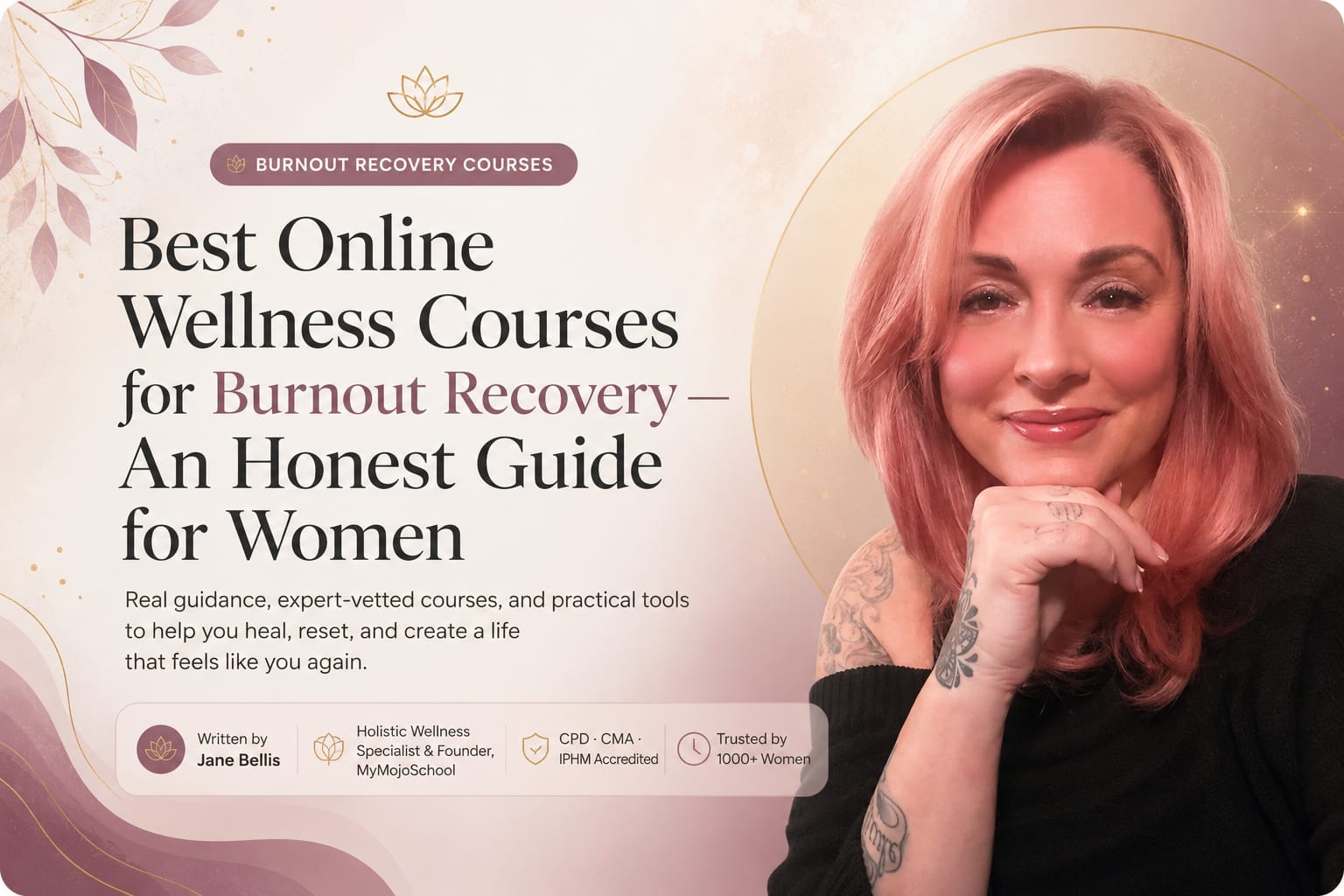
Replace YOUR-COVER-IMAGE-URL-HERE with the final cover image URL.
I am Jane Bellis, founder of MyMojoSchool, so I am not pretending to review my own work from the outside. I am writing this as the person who created these programmes after seeing too many women receive generic wellbeing advice that never reached the real pattern underneath their burnout.
An online wellness course is worth it when it matches your burnout pattern, works through recovery in the right order, and gives you a structure you can actually follow in real life. It is usually not worth it when it gives generic advice, asks you to do too much too soon, or leaves you alone when you need direct support.
You may have been here before. You paid for something that promised to help with exhaustion, anxiety, low mood, stress, or the feeling that you were barely keeping yourself together. For a short while, it helped. You felt motivated. You downloaded the workbook. You watched the first few lessons. Then life became loud again, and the course slowly joined the folder of things you once tried.
That does not mean you failed. It usually means the support did not match what was actually happening underneath your burnout.
Before choosing any course, it helps to understand the pattern you are dealing with. If you are still trying to work out whether this is burnout at all, start with my guide to the signs of burnout in women. If you already know you are burnt out but do not understand your type, the 5 types of burnout in women will give you a clearer starting point.
When an Online Wellness Course Is Actually Worth It
A course can be genuinely useful when it gives you a structured recovery path instead of another list of self-care tips. Burnout recovery is not simply about resting more. It usually involves your nervous system, emotional patterns, body signals, boundaries, identity, and the way you have learnt to measure your worth.
That is why I would not recommend choosing a course only because it looks beautiful, has a strong promise, or feels inspiring in the moment. Inspiration is easy. Sustained recovery needs structure.
For burnout recovery, I look for three things.
- It should match your burnout pattern. A woman who burns out from overachieving does not need exactly the same recovery route as a woman who burns out from people-pleasing, caring for everyone else, or losing connection with her body.
- It should follow a clear recovery sequence. If the nervous system is still overwhelmed, deep values work may feel impossible. If the emotional pattern is ignored, breathing exercises alone will not hold.
- It should be realistic for a tired woman. The right course does not demand a new perfect routine. It gives you small, repeatable steps that can fit into an already full life.
This is the same logic behind my week-by-week burnout recovery plan for women: start with stabilisation, then begin the deeper pattern work, then rebuild energy, boundaries, and direction.
Why So Many Wellness Courses Do Not Create Lasting Change
Most disappointing course experiences can be traced back to one of four problems. None of them mean you were lazy, inconsistent, or impossible to help.
The course addressed the wrong layer
A mindfulness course may calm you for ten minutes, but if your burnout is driven by perfectionism or fear of disappointing people, the stress pattern will keep returning.
The advice stayed too close to the surface
Sleep tips, journalling prompts, and boundary scripts can help, but only when the deeper reason you override yourself is also addressed.
The sequence was wrong
If a course asks you to rebuild your life while your nervous system is still overloaded, it may feel like another demand rather than support.
You needed support, not only information
Some women do not need more content. They need someone to help them apply it to their actual situation.
If your main issue is overthinking, emotional spiralling, or constant self-questioning, you may also find my guide on how to stop overthinking useful before choosing a course.
Is a Course or 1:1 Support Better for You Right Now?
The right next step depends on how depleted you are, what you have already tried, and how much support you need to stay with the work.
Why I Created the Burnout Recovery Course for Women
I created the Burnout Recovery for Women Course because I kept seeing the same problem: women were being told to rest, meditate, drink water, take time off, and set boundaries, but nobody was helping them understand why those things felt so difficult to sustain.
Most women do not burn out because they know nothing about wellbeing. They burn out because their lives, responsibilities, nervous systems, habits, roles, and self-worth patterns have been pulling in the same direction for years.
That is why the course is built around several recovery dimensions rather than one quick fix: nervous-system regulation, emotional pattern work, body restoration, boundaries, self-worth, and rebuilding a relationship with yourself that is not based only on productivity or being needed.
“The goal is not to give you one more thing to perform. It is to help you understand what has been keeping you in survival mode, then rebuild from there.”
If boundaries are one of your biggest sticking points, my guide on setting boundaries when you are burnt out may help you see why boundaries often collapse when the nervous system is already exhausted.
Looking for a structured course designed for women?
The Burnout Recovery for Women Course is designed to help you move from recognising burnout to actively rebuilding energy, emotional steadiness, boundaries, and self-connection through a self-paced recovery pathway.
When 1:1 Coaching May Be the Better First Step
A course is not always the right first step. Sometimes you need a real conversation before you need more lessons. This is especially true if your burnout is connected to a complex decision: whether to stay in a job, how to ask for support, what to do about a relationship dynamic, or how to stop carrying a role that no longer fits.
In a 1:1 coaching session, the work is more direct. We look at your situation, your burnout pattern, what you have already tried, and what needs to change first. For some women, this gives them the clarity they need before entering a self-paced course. For others, it becomes the support that helps them apply the course more honestly.
If your symptoms include severe depression, thoughts of self-harm, persistent panic, or symptoms that feel medically concerning, please speak to your GP or a qualified health professional. A course can support wellbeing, but it is not a replacement for medical or clinical care.
Ready to choose your next recovery step?
Start with the self-paced Burnout Recovery for Women Course, or book a 1:1 session if you need personalised support for your situation.
Frequently Asked Questions
Is an online wellness course worth it for burnout recovery?
Yes, when the course is specific, structured, and realistic. A useful course should address the pattern underneath burnout, not only give general self-care tips. It should also be something a tired woman can actually follow.
Why have online wellness courses not worked for me before?
Often because the course addressed the wrong layer, stayed too surface-level, started at the wrong point in the recovery process, or did not give you enough support to apply the work to real life.
Should I choose the course or 1:1 coaching?
Choose the course if you want a self-paced structure and have enough capacity to work through it gradually. Choose 1:1 coaching if your situation is complex, you need accountability, or you keep getting stuck when you try to recover alone.
How long does burnout recovery take?
It depends on the depth and duration of burnout, but most women need more than a weekend reset. A structured course can help you begin the process, but rebuilding energy, boundaries, and nervous-system steadiness often takes sustained practice.
Can I do a burnout recovery course while seeing a therapist?
Yes. Many women use a course alongside therapy or medical support. The course gives burnout-specific structure, while therapy may support deeper clinical, relational, or trauma-related work.

About Jane Bellis
Jane Bellis is a holistic wellness specialist and founder of MyMojoSchool, an accredited online wellness platform designed for women. Jane supports women in identifying the specific burnout pattern underneath their exhaustion and choosing a recovery pathway that matches the root cause rather than generic self-care advice.
Accredited by: CPD Group · Complementary Medical Association (CMA) · International Practitioners of Holistic Medicine (IPHM)